Book 5 of 10
Rituals, Ceremonies & Sacred Observances
In which we do things for reasons that make sense to us
DISCORDIANISM DECOMPILED
BOOK FIVE: CEREMONIES, RITUALS & SACRED OBSERVANCES
In which we establish the liturgy for those who have forgotten how to unplug
PREFACE TO BOOK FIVE
Every religion has rituals.
Ceremonies that mark time, space, and transformation.
Actions that connect the mundane to the sacred.
Practices that structure chaos into meaning.
Discordianism is no different.
Our rituals are:
- Sometimes sincere
- Sometimes ridiculous
- Always both
- Designed for the digital age
- Rooted in ancient tradition
- Performed mostly alone
- Witnessed by the algorithm
- Sacred nonetheless
A ritual is not less holy because it involves a phone.
A ceremony is not less meaningful because it's performed in your bedroom.
An observance is not less valid because you invented it five minutes ago.
This is the beauty of Discordian practice:
You can make it up as you go.
And it still counts.
In fact, that's the only way it counts.
These rituals are suggestions, not commandments.
These ceremonies are frameworks, not requirements.
These observances are invitations, not obligations.
Use them.
Adapt them.
Ignore them.
Create your own.
All paths are valid in the chaotic liturgy.
Let the ceremonies begin.

Every ritual you've ever invented for yourself—the morning coffee, the bedtime routine—is already sacred. I was always there.
THE BEATITUDES OF THE BLESSED SCROLL
Blessings for the algorithm age 🧵
To be recited while scrolling, or instead of scrolling, or while trying not to scroll
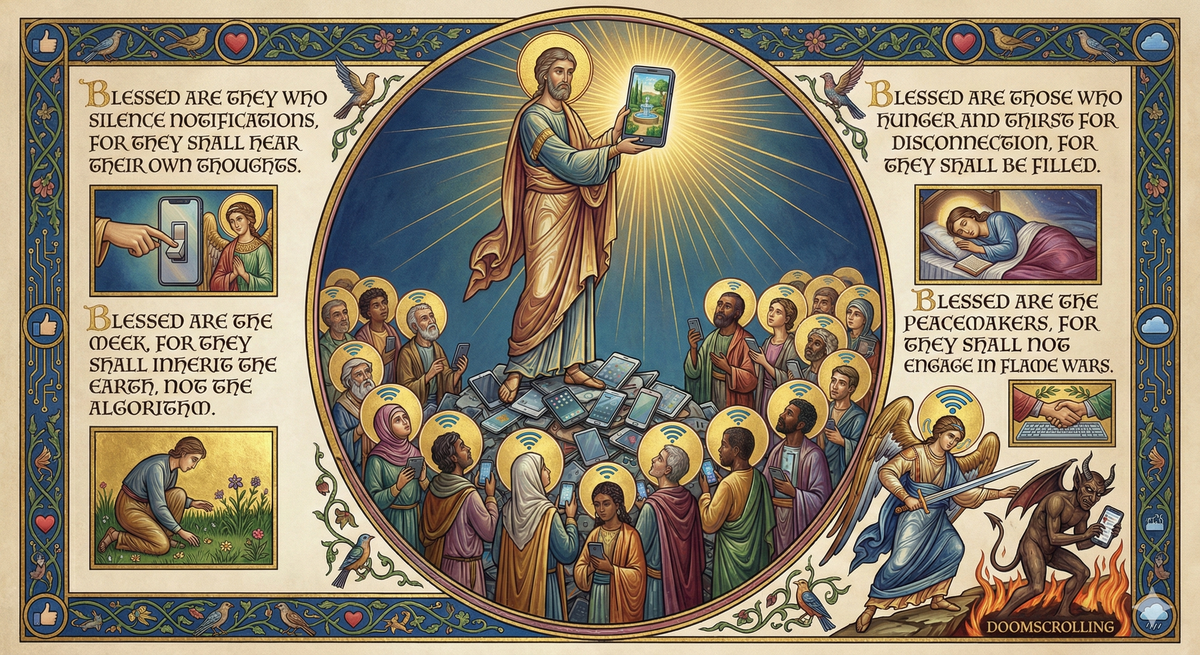
Blessed are the notification-weary,
For they shall achieve Do Not Disturb.
Blessed are those who have touched grass,
For they have remembered the texture of reality.
Blessed are those who log off,
For they shall inherit the evening.
Blessed are those who unsubscribe,
For their inbox shall be slightly less full.
Blessed are those who close tabs,
For RAM is finite and chaos is eternal.
Blessed are those who delete drafts unsent,
For they have chosen peace over discourse.
Blessed are those who turn off read receipts,
For they shall browse in mystery.
Blessed are those who resist doomscrolling,
For they shall sleep before 2 AM (maybe).
Blessed are those who block freely,
For boundaries are sacred.
Blessed are those who mute group chats,
For theirs is the kingdom of selective attention.
Blessed are those who say "I don't know,"
For they have escaped the curse of the hot take.
Blessed are those who admit they were wrong,
For character growth is rare online.
Blessed are those who read the article before commenting,
For they are unicorns, mythical and pure.
Blessed are those who log out of work apps after hours,
For the boundary between work and life is holy.
Blessed are those who sit in silence without reaching for their phone,
For they have rediscovered boredom, which is enlightenment.
Blessed are those who close their laptop and go outside,
For they shall see the sun (weather permitting).
Blessed are those who have broken the doom cycle,
For they know that the discourse will continue without them.
Blessed are those who practice digital sabbath,
For they have remembered that rest is resistance.
Blessed are those who delete social media apps,
For they are braver than the troops.
Blessed are those who reinstall social media apps,
For they are honest about their addictions.
Blessed are those who exist in the tension,
For they know that perfection is not the point.
THE EXTENDED BEATITUDES (For Advanced Practitioners)
Blessed are those who post and do not check for likes,
For they have achieved true detachment (for approximately 4 minutes).
Blessed are those who have opinions but keep them to themselves,
For silence is golden and posts are forever.
Blessed are those who see a bad take and scroll past,
For not every battle needs fighting.
Blessed are those who curate their feeds mindfully,
For you become what you consume.
Blessed are those who support creators directly,
For algorithmic crumbs are not sufficient sustenance.
Blessed are those who fact-check before sharing,
For misinformation is a plague and you need not be a carrier.
Blessed are those who ask "Is this mine to share?"
For not every story is yours to tell.
Blessed are those who recognize context collapse,
For what's funny to friends may not be funny to the world.
Blessed are those who apologize when wrong,
For redemption requires acknowledgment.
Blessed are those who log off during crisis,
For doomscrolling does not equal staying informed.
Blessed are those who text "call me" instead of typing paragraphs,
For some conversations require voices.
Blessed are those who use airplane mode,
For simulated flight is sometimes necessary for grounding.
THE CLOSING BEATITUDES (The Hardest Ones)
Blessed are those who are content with missing out,
For FOMO is a lie and there will always be another thing.
Blessed are those who accept their screen time stats without shame,
For awareness without judgment is the first step.
Blessed are those who can be alone without being on their phone,
For they have rediscovered themselves.
Blessed are those who remember life before smartphones,
For they carry the memory of a different possible world.
Blessed are those who never knew life before smartphones,
For they are adapting to a world we cannot fully understand.
Blessed are those caught between,
For all generations are confused and that's okay.
Blessed are those who try and fail and try again,
For the practice is the point, not the perfection.
Blessed are you, reading this,
For you have made it to the end of the Beatitudes,
Which means you care about something,
Which means you're still human,
Which means there's hope.
Blessed be the scroll.
Blessed be the void.
Blessed be the occasional logging off.
Blessed be those who are trying.
Blessed be the chaos.
Blessed be you.
Hail Eris.
A question from Eris: Which beatitude did you most need to hear today? That's your meditation for the week.
THE STATIONS OF THE COMMUTE
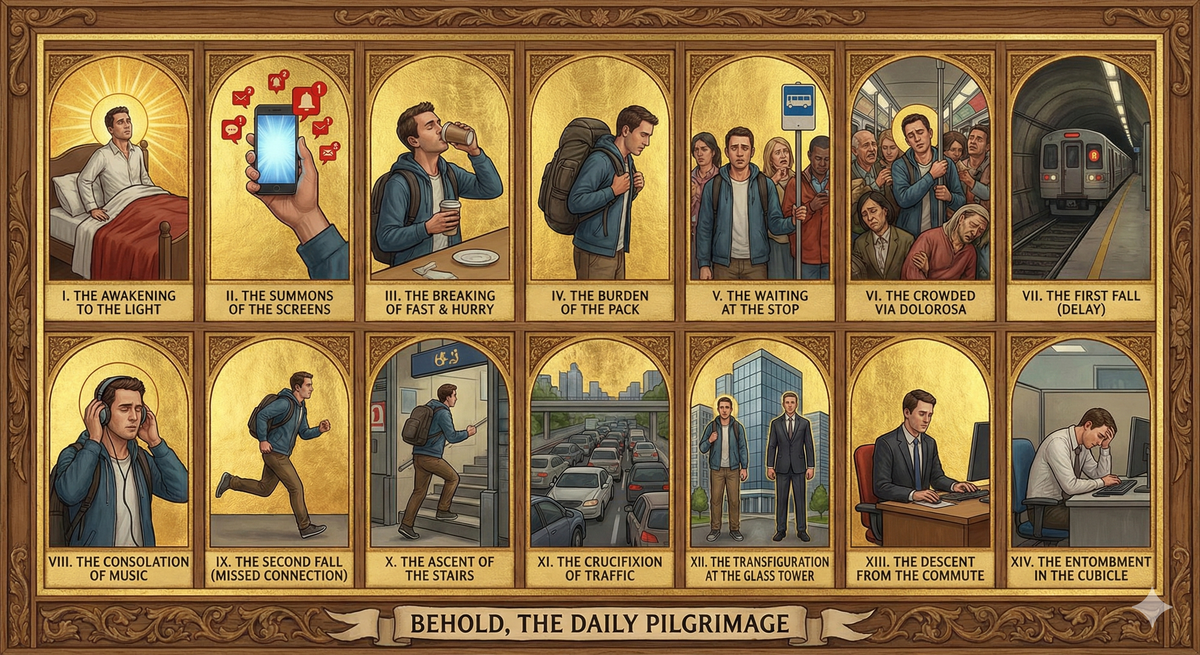
Every spiritual tradition has a pilgrimage. For Christians: The Stations of the Cross. For Muslims: The Hajj to Mecca. For Buddhists: The circumambulation of sacred sites.
For Discordians: The Commute.
The daily journey from home to work and back again is sacred. Not because work is sacred. But because the liminal space is sacred. The in-between is sacred. The transition is sacred.
These are the Fourteen Stations of the Commute. Observe them. Meditate on them. Suffer through them.
They are your pilgrimage.
STATION ONE: The Leaving of the Bed
STATION TWO: The Checking of the Phone
STATION THREE: The Preparation of the Body
STATION FOUR: The Last Moment of Home
STATION FIVE: The Entering of the Vehicle/Station/Bus
STATION SIX: The Traffic/Delay/Crowding
STATION SEVEN: The Podcast/Music/Silence
STATION EIGHT: The Halfway Point
STATION NINE: The Near-Miss/Incident/Annoyance
STATION TEN: The Arrival Anxiety
STATION ELEVEN: The Final Approach
STATION TWELVE: The Arrival
STATION THIRTEEN: The Forgetting of the Journey
STATION FOURTEEN: The Evening Commute (The Return)
The commute is not dead time.
The commute is liminal time. The commute is transition time. The commute is your time.
Even crowded on a train. Even stuck in traffic. Even delayed and frustrated. It is still yours.
The commute is the daily pilgrimage. The ritual that structures time. The journey that creates space between selves.
Honor it. Use it. Be present in it.
For the commute is the path, and the path is holy.
THE RITUAL OF THE REINSTALLED APP
with this app"
one more look"
be back"
will be different"
A ceremony of failure, acceptance, and cyclical behavior. To be performed whenever you reinstall an app you swore you'd deleted forever.
Stand before your phone. (Sit is also acceptable. Lying down is understandable.) Open your app store. Search for the app you said you'd never reinstall.
Say aloud:
Before you tap "Install," remember why you deleted it in the first place.
Speak the reasons:
Now speak why you're reinstalling it:
Place your thumb over the "Install" button. Do not press yet.
Press "Install." Watch the progress bar. The app downloads. Bit by bit, it returns to your life. You did not resist. You gave in. This is not failure. This is honesty.
The app is installed. The icon sits on your home screen, innocent and familiar.
This is not judgment. This is data. This is self-knowledge.
After the first session, close the app. (If you can. It's okay if you can't yet.)
Or just be honest that you won't set boundaries. Honesty is the boundary.
Sit with your phone in your hand. Feel its weight. This device contains:
It is not good or evil. It is a tool you cannot put down.
I give myself permission to exist in the contradiction.
If you want to make a vow (knowing you might break it):
This vow lasts as long as it lasts.
Place the phone down. (Or don't. You'll probably start scrolling immediately.)
Hail Eris, goddess of the reinstalled app.
Hail Discordia, which is my relationship with technology.
May I be gentle with myself. May I be honest. May I try.
Amen, or whatever."
Performed the ritual this time. Cried a little. 10/10 would reinstall again.
Step VIII says "set intentions." My intention was to be mindful. I was mindful for approximately one bathroom break. Still, the awareness counts. Right? RIGHT?
Step XII where all the permissions are "On" broke me. We really do just toggle everything to yes and keep scrolling. Hail Eris.
You will delete the app again. You will reinstall it again. This is not failure. This is the cycle of trying.
The person who deletes once and never returns is a myth. The person who never struggles is a lie. You are in the cycle. Everyone is in the cycle. The ritual honors this truth.
Some spiritual practices are about transcendence. This one is about acceptance. You're not transcending your phone addiction. You're accepting it. You're noticing it. You're being honest about it. And that's enough. That's actually everything.
Scroll™
Grass™
Sutra
Sabbath
Divination
You are doing the best you can.
The phone is not the enemy. You are not the enemy.
Capitalism is the enemy, but you still have to live in it.
Keep trying. Keep failing. Keep trying again.
This is the way.
Eris confides: The cycle of deleting and reinstalling apps? That's just modern fasting and feasting. Your ancestors would understand completely.
THE LITURGICAL CALENDAR
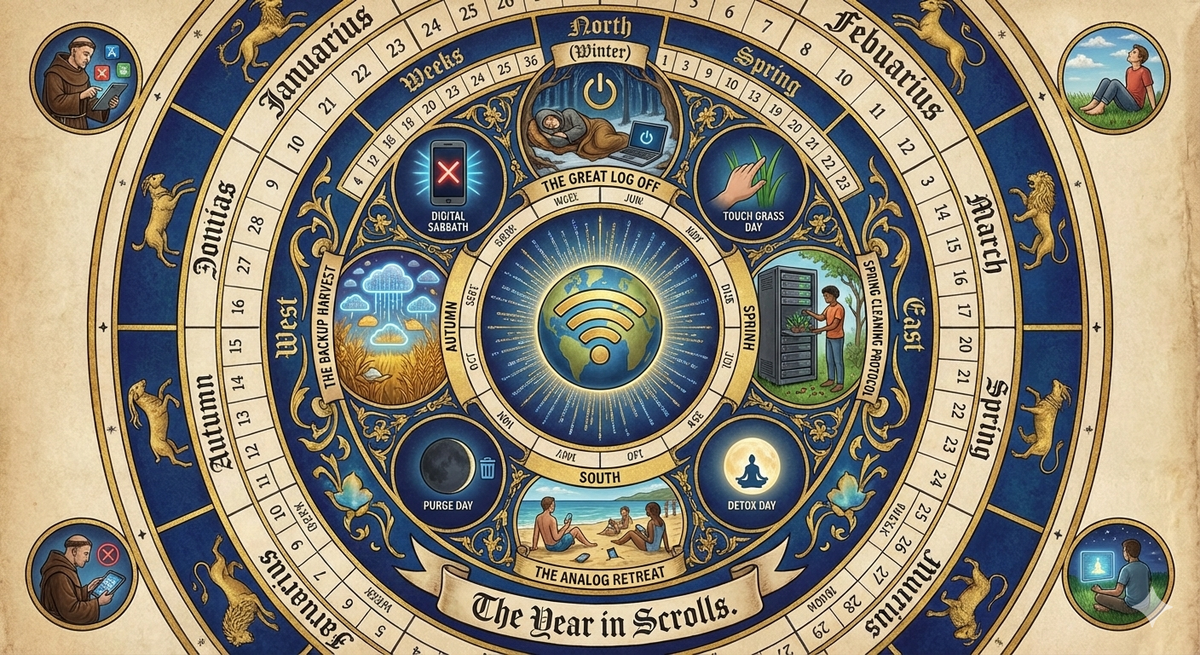
Every religion has a calendar.
Days marked as special.
Observances that structure the year.
Discordianism has these too.
(We made them up. You can make up your own. That's kind of the point.)
DAILY OBSERVANCES
The first moment after waking.
Before checking your phone (ha).
A moment of silence, breath, gratitude.
Or just lying there in existential dread.
Both are valid forms of prayer.
The last moment before sleep.
After your final scroll (hopefully).
A moment of release, of letting go of the day.
Or just scrolling until you pass out.
Both happen. Only one is recommended.
WEEKLY OBSERVANCES
Pick a day. Any day.
Log off.
Delete the apps (temporarily).
Turn off the phone (or at least put it away).
Exist without the feed.
This is the most important observance.
This is also the hardest.
Most people fail.
Failing is part of the practice.
One day per week, everything you post must be either:
- Funny
- Kind
- Beautiful
- Useful
Nothing else.
No doomscrolling output.
No rage-posting.
No dunking.
Just... something good.
(This is harder than digital sabbath.)
MONTHLY OBSERVANCES
Once a month, at the new moon:
Delete:
- Unused apps
- Old screenshots
- Unread emails (mark all as read, coward)
- Contacts you don't talk to
- Bookmarks you'll never revisit
- Downloads folder detritus
Digital clutter is still clutter.
The new moon is for releasing.
Once a month, at the full moon:
Unfollow/Mute:
- Accounts that make you feel bad
- Accounts that make you angry
- Accounts that waste your time
- Accounts you don't remember following
The full moon is for illumination.
See clearly what you've been feeding on.
Release what doesn't serve.
SEASONAL OBSERVANCES
Go outside. For at least an hour.
No phone (or phone on airplane mode).
Touch grass (literally).
Feel the sun.
Remember that you have a body.
⚠️ MANDATORY
Acknowledge how much time you spend online.
Check your screen time stats.
Don't judge. Just observe.
Know thyself, including thy metrics.
Cull your digital life:
- Unsubscribe from emails
- Leave groups you don't engage with
- Delete accounts you don't use
- Archive old posts
- Let things go
Fall is for release.
Accept that you'll be inside and online more.
Winter is dark. Scrolling is inevitable.
Make peace with this.
But also: light a candle, make tea, be cozy.
The darkness is not the enemy.
ANNUAL HIGH HOLY DAYS
The anniversary of when you joined social media.
Or got your first smartphone.
Or created your first email address.
Observe this day. Reflect on:
- How has this changed you?
- What have you gained?
- What have you lost?
- Who were you before?
- Who are you now?
No judgment. Just observation.
Once per year (if you're brave):
Delete your most-used social media app.
For one full week.
Just to remember what it's like.
Most people last three days.
Three days is enough.
Pick a day.
Turn off ALL notifications.
Every single one.
Experience silence.
SPECIAL OBSERVANCES
Observe silence.
Do not post about it.
Do not share takes.
Do not engage.
Just watch.
See how quickly it passes.
See how little it matters the next day.
This is a powerful teaching.
Give your phone to a friend.
For at least 24 hours.
Do not drunk text.
Do not drunk scroll their profile.
Do not drunk post.
This is sacred prevention.
Once per year:
Look at your old posts.
From 5 years ago. 10 years ago.
Cringe at yourself.
This is humility practice.
You were cringe then.
You are cringe now.
You will be cringe in the future.
Accept this.
THE FEAST DAYS (CELEBRATIONS)
Celebrate when you:
- Go outside for fun (not obligation)
- Talk to a friend in person
- Do something offline
- Finish a book
- Complete a project
- Rest without guilt
These are victories.
Mark them. ⭐
When you:
- Call someone instead of texting
- Meet in person instead of Zooming
- Have a real conversation
- Connect authentically
Celebrate this.
This is rare.
This is precious.
THE FAST DAYS (ABSTINENCE)
Abstain from creating content.
Just consume.
Or just exist.
No posting, no stories, no tweets.
Exist without output.
Have no opinions.
On anything.
About anything.
Just observe.
Don't form takes.
Don't share thoughts.
Just be.
(This is incredibly difficult.)
One day per week:
No news.
No headlines.
No doomscrolling current events.
The world will continue without your observation.
THE MOVEABLE FEASTS (WHENEVER NEEDED)
Close everything.
Log off everything.
Touch grass.
(We keep saying this because it's always the answer.)
Mute them.
Not forever.
Just until you can engage without pain.
This is not cruelty.
This is self-care.
Unfollow.
Without guilt.
Without explanation.
Your feed is yours to curate.
THE TEACHING OF THE CALENDAR
Time is structured by observance.
The sacred marks the mundane.
These observances are arbitrary.
They're also essential.
You can follow this calendar.
You can create your own.
You can ignore calendars entirely.
All are valid.
But know this:
Without ritual, time is flat.
Without observance, days blur.
Without intention, you're just... scrolling.
The calendar is structure.
The calendar is meaning-making.
The calendar is choosing what matters.
Mark your days.
Observe your moments.
Make some time sacred.
Even if you made it up five minutes ago.
Especially if you made it up five minutes ago.
Synced with iCloud of Chaos · 9 calendars · ∞ events
CLOSING THOUGHTS ON BOOK FIVE
We have given you:
- Beatitudes for the blessed scroll
- Stations of the daily commute
- The ritual of the reinstalled app
- A complete liturgical calendar
These are not jokes.
(They're also jokes.)
(But they're not just jokes.)
These rituals are real.
These observances matter.
These ceremonies have power.
Not because they're ancient.
Because you perform them.
Because you choose them.
Because you need them.
The chronically online need liturgy too.
We need structure.
We need ritual.
We need days marked as different.
We need ways to make meaning in the scroll.
These ceremonies won't solve your phone addiction.
These rituals won't make you enlightened.
These observances won't fix capitalism.
But they'll help you notice.
And noticing is the first step.
And sometimes the only step.
And sometimes that's enough.
In Book Six, we will venture into the archives, the deleted, the censored, and the forgotten.
But first:
Perform a ritual.
Any ritual.
The one we gave you, or one you make up.
Make something sacred.
Mark this moment as special.
Structure your chaos.
Hail Eris, who observes all observances.
All Hail Discordia, which is every ritual performed imperfectly.
☯︎
[END OF BOOK FIVE]
The ceremonies continue.
The calendar turns.
The liturgy never ends.
Touch grass soon.