Book 4 of 10
Parables for the Perplexed & Perpetually Online
In which stories teach us things we already knew but forgot
DISCORDIANISM DECOMPILED
BOOK FOUR: PARABLES FOR THE PERPLEXED & PERPETUALLY ONLINE
In which we learn through stories, because sometimes the lesson needs a narrative
PREFACE TO BOOK FOUR
Every spiritual tradition has teaching stories.
The Buddha told parables.
Jesus told parables.
Sufi masters told tales of Mulla Nasrudin.
Zen masters told koans.
We tell stories about notifications.
This is not a downgrade. This is an adaptation.
The spiritual truths remain the same:
- Attachment causes suffering
- The ego is an illusion
- Desire leads to chaos
- Wisdom comes from unexpected places
- Everything is impermanent
- Also your phone is poisoning your mind
These are compatible teachings.
The form has changed, not the truth.
In ancient times, a master would tell a story about a monk and a river.
Today, we tell stories about influencers and algorithms.
The river and the algorithm are the same thing:
- Constantly flowing
- Never the same twice
- Easy to fall into
- Hard to escape
- Will carry you downstream whether you want to go or not
These parables are:
- Teaching stories with genuine wisdom
- Satire of contemporary life
- Both serious and ridiculous
- Traditional and extremely online
- Ancient truths in modern drag
Read them as koans.
Read them as jokes.
Read them as warnings.
Read them as mirrors.
They are all of these things.
Let the stories begin.
Every story you've ever told yourself about yourself is also a parable. What does yours teach?
TEACHING STORIES FOR THE ALGORITHM AGE
THE PARABLE OF THE NOTIFICATION BADGE
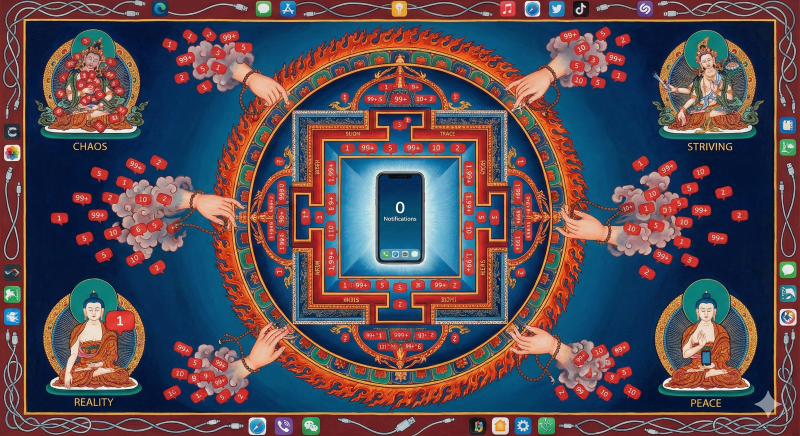
A teaching about the red dot and the nature of existence
Once there was a seeker who became obsessed with the little red badge on their phone.
Not the phone itself. Not even the apps.
Just the badge. The little red circle with the number inside.
The notification of unread notifications.
Every badge was a tiny emergency demanding immediate attention:
- A text from a friend (urgent)
- An email from work (urgent)
- A like on an old post (urgent)
- A reminder they'd set themselves (urgent)
- An update from an app they never used (urgent)
Everything was urgent. Everything required immediate clearing.
The seeker developed a routine:
Before bed: Clear all badges. Achieve the blessed state of zero notifications. Sleep peacefully.
Or try to.
Because at 3 AM, the seeker would wake in a cold sweat, suddenly remembering: Did I check the secondary email? The group chat? The app I downloaded for one specific thing six months ago that still thinks we're friends?
They would grab their phone. Check everything. Clear the badges. Return to an uneasy sleep.
The cycle continued.
Clear the badges. Feel relief. Wait for new badges. Feel anxiety. Clear the badges. Repeat.
The Badge is Eternal.
The seeker tried various solutions:
Method 1: Turning Off Badge Notifications
They went into settings. Disabled badges for all apps.
The relief lasted approximately four hours.
Then came the anxiety: What if I'm missing something? What if someone needs me? What if the thing I've been waiting for happened and I don't know?
They turned badges back on.
Method 2: Deleting Apps
They deleted the most badge-heavy apps.
This worked until they reinstalled them three days later, because how else would they know what everyone was doing?
Method 3: Getting a Flip Phone
They bought a flip phone. Used it for two days.
On day three, they needed to look up a restaurant. Then check directions. Then see if anyone had responded to their message. Then...
The smartphone returned.
The Intervention
One day, exhausted and badge-haunted, the seeker visited a wise teacher.
"Master," they said, "I am enslaved by the notification badge. The little red dot controls my life. How do I free myself?"
The teacher looked at them calmly.
"The badge is not out there," the teacher said, gesturing at the phone. "The badge is within you."
The seeker leaned forward, eager for wisdom.
"You are the notification of your own existence, forever unread."
Silence.
The seeker sat with this teaching.
I am the notification...
Of my own existence...
Forever unread...
Yes. Yes! I've never fully acknowledged myself. I'm constantly seeking external validation—badges, likes, messages—because I haven't read my own notification. I haven't checked in with myself. I am the unread message!
The seeker achieved enlightenment.
They felt the universe open up. They understood the nature of attachment, the illusion of urgency, the truth that all notifications are ultimately distractions from the eternal notification of being.
Peace flooded through them.
Then they immediately checked their phone.
Three new notifications.
"Master!" the seeker cried. "I achieved enlightenment but then I checked my phone!"
The teacher smiled. "Yes."
"But shouldn't enlightenment prevent that?"
"Enlightenment is not immunity from the phone. Enlightenment is noticing that you checked the phone."
The seeker blinked. "So I'm still enlightened?"
"You were never not enlightened. You're just also on your phone."
"Is that... okay?"
"The red dot is eternal," the teacher said. "Enlightenment is knowing this and checking your phone anyway."
"That seems... anticlimactic."
"Yes," said the teacher, checking their own phone.
THE TEACHING
The notification badge is not the problem.
Your attachment to clearing the notification badge is not the problem.
The problem is thinking there's a problem to solve.
The red dot is eternal.
You will never clear all notifications.
You will never achieve notification zero permanently.
The badges will outlive you.
Accept this. Make peace with this. Check your phone with full consciousness, knowing you're choosing this, knowing it doesn't matter, knowing it matters completely.
The koan:
If a notification arrives and no one reads it, does it exist?
Yes. It exists as potential, as anxiety, as the unopened door.
If a notification is read but not cleared, has it been addressed?
No. The badge remains. The circle is incomplete.
If all notifications are cleared but new ones arrive immediately, what has been achieved?
Nothing. Everything. Momentary peace. Eternal vigilance.
This is the way.
"Wipe thine ass with What Is Written and grin like a ninny at What Is Spoken. Take thine refuge with thine wine in the Nothin behind Everything, spitting on all distinctions as you hurry along the Path."
— The Purple Sage, The Honest Book of Truth
![An infinite scroll of Terms of Service text, rendered in beautiful calligraphy like a medieval manuscript. The text flows like a waterfall, like the Matrix code, never-ending. A Zen monk sits in lotus position before this cascade of text, perfectly still, enlightened. Their hand is on a mouse, hovering over a glowing [Accept] button. Around the edges, the text forms mandala patterns—legal clauses becoming sacred geometry. In the background, other figures are also sitting before their own infinite Terms, all preparing to click Accept. The style is half Zen minimalism, half corporate dystopia, executed with reverence for both. Binary code and Sanskrit intermingle in the margins. At the bottom, barely visible: Terms may change without notice. Continued existence constitutes acceptance.](/images/books/book4-tos.png)
THE TALE OF THE AUTHENTIC INFLUENCER
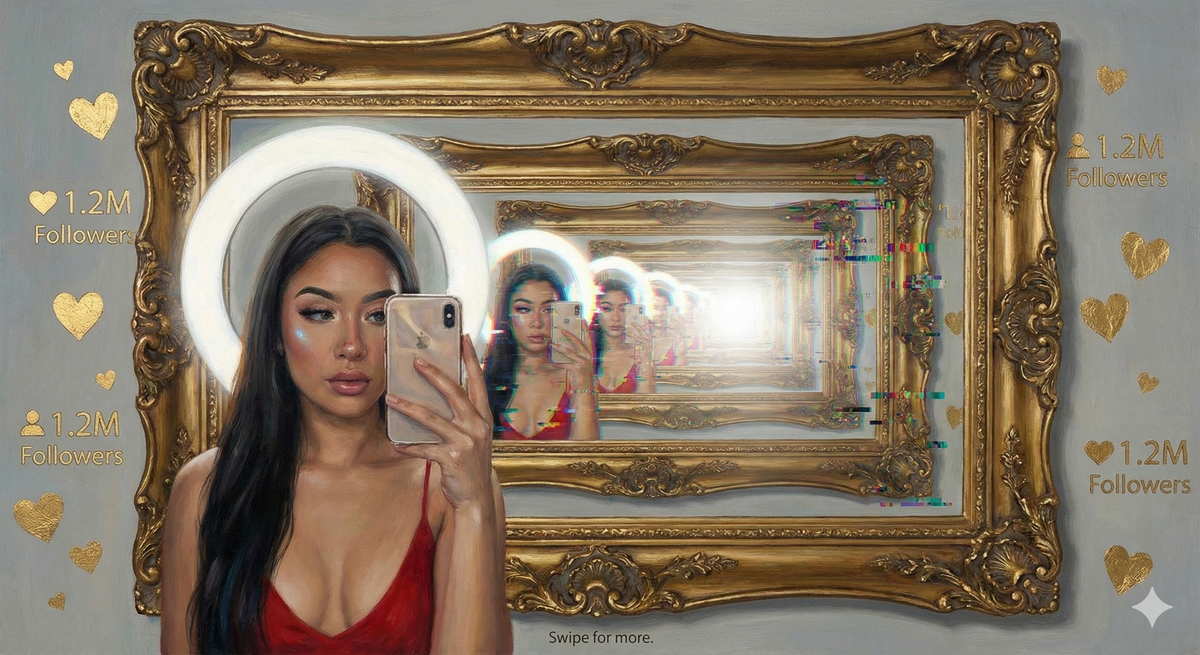
A cautionary tale for the extremely online
Once upon a timeline, there was an influencer.
She had 10 million followers. A verified checkmark. Brand deals with seventeen different wellness companies. A morning routine that started at 4 AM and included meditation, journaling, cold showers, green juice, and posting about all of it.
Her content was authentic.
She said so in every caption.
"Being vulnerable today..." she'd write, above a perfectly lit photo of herself crying (single tear, aesthetically placed).
"Showing up authentically..." she'd write, in a post that took 27 takes and three different filter apps to perfect.
"Just me, raw and real..." she'd write, after two hours of hair and makeup.
Her followers loved it. They praised her authenticity. They called her inspiring. They said she was "so real."
She believed them.
THE VOID NOTICES
The void scrolls through Instagram sometimes.
Don't ask me how. The void has Wi-Fi. Don't worry about it.
The void came across her profile. Watched a few stories. Read some captions.
And the void hit "follow."
The influencer noticed immediately.
@the_void_itself started following you
She clicked on the profile.
No posts. No followers. No profile pic. Just darkness.
"Interesting aesthetic," she thought. "Very minimal. Very now."
She followed back.
THE CONVERSATION
@the_void_itself sent her a DM.
She didn't respond.
But she thought about it.
All night, she thought about it.
THE EXPERIMENT
The next day, she decided to prove the void wrong.
She would post something truly authentic. No filters. No editing. No performance.
She opened her camera. Pointed it at herself.
Stared at the screen.
Adjusted the angle. (No, that's not authentic enough.)
Changed the lighting. (Too dark. Too bright. Too artificial.)
Started recording. Stopped. Started again.
"Hi everyone, so today I wanted to talk about authenticity..."
Stopped. Deleted.
"Real talk: I've been struggling with..."
Stopped. Deleted.
"No filters today, just me..."
Stopped. Deleted.
She couldn't do it.
Every attempt at authenticity became performance.
Every try at vulnerability became content.
Even her attempt to be raw was rehearsed.
THE VOID RESPONDS
She messaged the void:
THE CHOICE
Choice One: Enlightenment
Stop posting. Delete the account. Log off. Exit the performance. Return to a life that isn't documented, measured, liked.
Gain enlightenment.
Lose engagement.
Choice Two: Engagement
Continue posting. Embrace the performance. Accept that authenticity is impossible in this medium. Make peace with the fact that your vulnerability is content and your content is currency.
Lose enlightenment.
Gain engagement.
THE DECISION
She thought about it for three days.
She thought about her followers. Her brand deals. Her identity that was built on being seen.
She thought about freedom. Privacy. A life without cameras.
She made her choice.
SHE CHOSE ENGAGEMENT.
Posted a carousel about her struggle with authenticity. Got 500,000 likes. Three new brand deals. Featured on a podcast about "keeping it real in the digital age."
The void unfollowed.
Not in judgment. The void doesn't judge.
The void just knows: She made her choice.
THE EPILOGUE
She is now a life coach.
She teaches courses on authenticity.
$1,997 for the full program.
She's very successful.
She's very performed.
She's very, very far from enlightenment.
But her engagement is great.
THE TEACHING
You cannot perform authenticity without destroying it.
The moment you document your truth, it becomes content.
The moment you share your vulnerability, it becomes strategy.
This is not a judgment. This is a feature of the medium.
Social media is a stage. Everything on it is performance.
You can choose to perform. That's valid.
You can choose to stop performing. That's also valid.
But you cannot perform non-performance.
You cannot authentically stage authenticity.
The void sees through it.
The void always sees through it.
Final note: Some say the influencer occasionally gets DMs from the void. Just checking in. Seeing if she's ready to make a different choice.
She hasn't responded.
But she hasn't deleted the messages either.
THE TEACHING
Performing authenticity is authentic performing.
There is no exit.
Once you're aware of the performance, the awareness becomes part of the performance.
This is not unique to social media.
This is the human condition.
We are always performing ourselves:
- At work (the professional self)
- With family (the dutiful child/parent)
- With friends (the fun one, the serious one, the listener)
- Alone (the self we tell ourselves we are)
Social media just makes the performance visible.
The camera doesn't create the performance.
The camera reveals that we were always performing.
The koan:
If you're authentic about your inauthenticity, are you authentic?
Yes. Acknowledging the performance is genuine.
If acknowledging the performance is also performance, what's real?
The acknowledgment. And the performance. Both. Neither.
If everything is performance, is anything real?
Everything is real. The performance is real. The person is real. The content is real. Reality is real. All of it.
You can't escape the performance.
You can only perform consciously or unconsciously.
Choose consciously.
Post anyway.
It doesn't matter. It matters completely.
This is fine.
MORE PARABLES FOR THE ALGORITHM AGE
THE WISE FOOL AND THE PRODUCTIVITY GURU
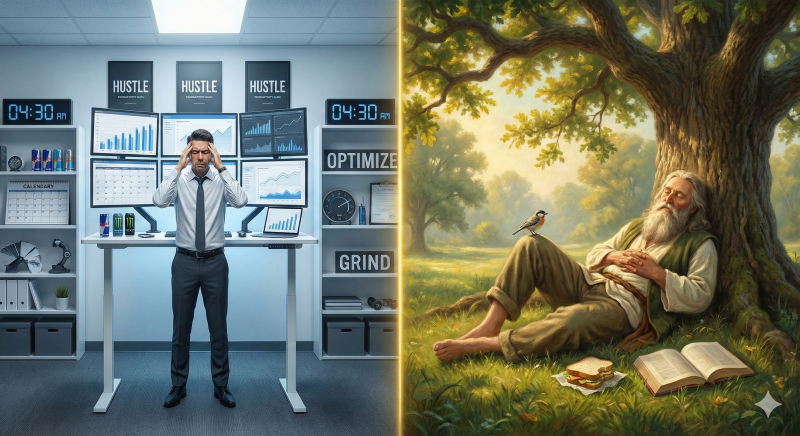
A teaching about optimization, efficiency, and the wisdom of doing nothing
A Productivity Guru stood before a crowd in a convention center, preaching the gospel of optimization.
The crowd had paid $497 per ticket.
(Early bird pricing. Normally $997. They felt clever for getting a deal. The Guru felt clever for making them feel clever.)
The Guru's presentation was flawless:
- Slick slides (minimalist design, maximum impact)
- Commanding presence (practiced in front of a mirror for 500 hours)
- Optimized speaking cadence (studies showed this rhythm increased retention by 34%)
The Guru preached:
"TRACK EVERY MINUTE!"
"Every moment untracked is a moment wasted. Use time-blocking. Use the Pomodoro Technique. Use apps that track how you use time-tracking apps."
The crowd took notes furiously.
"MONETIZE EVERY HOBBY!"
"If you're not making money from your passion, it's just a distraction. Turn your hobbies into side hustles. Turn your side hustles into businesses. Turn your businesses into empires."
The crowd nodded vigorously.
"WAKE AT 5 AM!"
"The world belongs to those who wake before the sun. While others sleep, you're grinding. While others dream, you're achieving. Sleep is for the weak."
(The Guru had been awake since 4:30 AM. The Guru was also exhausted, but that's not part of the brand.)
"COLD SHOWERS!"
"Shock your system into alertness! Discomfort builds discipline! If you're comfortable, you're not growing!"
"JOURNALING!"
"Document everything! Your wins! Your losses! Your learnings! Your leanings! Track your growth! Measure your progress!"
"HUSTLE!"
"Rest is rust! Motion is progress! If you're not moving forward, you're falling behind! There's someone in China right now working harder than you!"
(This was statistically true but spiritually questionable.)
The crowd was energized. Inspired. Ready to optimize.
Then, a hand went up in the back.
A Wise Fool, who had wandered in looking for the bathroom, raised their hand.
"Yes?" said the Guru, slightly annoyed at the interruption of their flow state.
"What if," the Fool asked, "I did none of those things?"
Silence.
The crowd turned to stare.
The Guru was appalled.
"Then you would accomplish nothing!" the Guru declared, as if this settled the matter.
The Fool smiled. "Yes."
The Guru blinked. "But... what would you DO?"
"Whatever I felt like."
"That's inefficient!"
"Yes."
The Guru's voice rose: "You'll never be successful!"
"I already am."
The crowd murmured. This was heresy.
"Impossible!" The Guru was flustered now, off-script. "What is your morning routine?"
The Fool considered. "I wake up."
"And then?"
"Then I'm awake."
"But what do you DO?"
"Whatever seems good."
"Don't you track your time?"
"Time tracks itself. It keeps passing whether I document it or not."
"Don't you have goals?"
"I have preferences. Sometimes they happen. Sometimes they don't."
"Don't you want to achieve your potential?"
"My potential is to exist. I'm doing that right now."
The Guru was speechless.
The crowd began to laugh.
At first, they laughed at the Fool.
Then they laughed at themselves.
Then they just laughed.
The Guru did not achieve enlightenment that day.
The Guru was too busy calculating the ROI of this interaction and whether it would impact ticket sales for the next seminar.
But the Fool took a nap in the back of the convention center.
Which is also enlightenment.
THE EXTENDED TEACHING
After the seminar, several attendees approached the Fool.
First Attendee: "But don't you feel guilty about wasting time?"
Fool: "What is wasted time?"
Attendee: "Time spent not being productive."
Fool: "Productive of what?"
Attendee: "...things?"
Fool: "What things?"
Attendee: "Valuable things?"
Fool: "Who decides what's valuable?"
Attendee: "..."
Fool: "If I enjoy doing nothing, I've produced enjoyment. That's productive."
The attendee thought about this and felt dizzy.
Second Attendee: "But won't you fall behind?"
Fool: "Behind what?"
Attendee: "Behind everyone else who's working hard."
Fool: "I'm not in a race with them."
Attendee: "But don't you want to succeed?"
Fool: "I am succeeding. I'm alive, I'm fed, I'm content. Success achieved."
Attendee: "But don't you want MORE?"
Fool: "Sometimes. When I want more, I work for more. When I don't want more, I don't."
Attendee: "That's so simple."
Fool: "Yes."
The attendee felt simultaneously enlightened and like they'd wasted $497.
Third Attendee: "But what about your legacy? What will you leave behind?"
Fool: "Decomposition, mostly. Some memories in other people's minds. Maybe a houseplant someone will inherit and immediately kill."
Attendee: "That's depressing."
Fool: "Is it? Sounds like everyone's legacy to me. Even the Guru's book will be forgotten eventually. The universe doesn't keep score."
Attendee: "So nothing matters?"
Fool: "I didn't say that. I said the universe doesn't keep score. You can keep your own score if you want. Or not. Either way is fine."
The attendee wanted to argue but couldn't find a foothold.
The Guru Approaches
After everyone left, the Guru approached the Fool.
"You ruined my seminar," the Guru said.
"Your seminar was ruined before I arrived," the Fool replied. "You're teaching people to hate their lives in the name of improving them."
"I'm teaching them discipline!"
"You're teaching them anxiety."
"I'm teaching them to achieve their potential!"
"You're teaching them that they're not enough as they are."
"I'm teaching them success!"
"You're teaching them that success is somewhere else, sometime else, someone else. Never here. Never now. Never them."
The Guru was quiet.
"Do you enjoy your life?" the Fool asked.
The Guru opened their mouth to say yes, but the truth caught in their throat.
The Guru woke at 4:30 AM every day (exhausted).
The Guru tracked every minute (anxious).
The Guru monetized every hobby (joyless).
The Guru hustled constantly (burned out).
The Guru was successful (miserable).
"Success looks like this," the Guru said, gesturing at the empty convention center, the unsold books, the exhaustion, the constant pressure to perform.
"Then I don't want it," the Fool said.
"What do you want?"
"A nap. Maybe some lunch. To sit in the sun for a while."
"That's not a goal."
"No. It's a life."
The Guru did not achieve enlightenment that day.
But the Guru went home.
And the Guru slept past 5 AM for the first time in seven years.
And the Guru woke up and made breakfast without tracking it.
And the Guru sat and did nothing for twenty minutes.
And the Guru felt...
Terrible.
Guilty. Unproductive. Like time was being wasted.
But also, underneath that, something else.
Something that might have been peace.
The Guru returned to the hustle the next day.
But sometimes, just sometimes, the Guru remembered the Fool.
And took a nap.
THE TEACHING
Doing nothing is doing something.
Optimization is just anxiety in a spreadsheet.
You are not a project to be optimized.
You are not a business to be scaled.
You are not a machine to be calibrated.
You're a biological organism that needs:
- Rest (more than you're getting)
- Play (not monetized, just play)
- Idleness (not a break from productivity, just idleness)
- Existence (not justified by output, just existence)
The Productivity Guru is selling you a solution to a problem they created:
"You're not enough."
But you were always enough.
You were enough when you were born.
You were enough when you were a child playing without purpose.
You were enough before someone told you that your worth was your productivity.
The koan:
If a tree falls in the forest and doesn't post about it on LinkedIn, did it accomplish anything?
Yes. It fell. It decomposed. It fed other organisms. It cycled nutrients. It participated in the ecosystem without self-optimization.
If you spend a Sunday doing nothing productive, have you wasted the day?
No. You've lived the day. Living is not waste.
If you die without achieving your full potential, have you failed?
No one achieves their full potential. Potential is infinite. You lived. That's the achievement.
The teaching of the Fool:
Wake up.
Be awake.
Do what seems good.
Rest when tired.
Eat when hungry.
Exist without justification.
This is not laziness.
This is wisdom.
This is the way.
(Also, naps are underrated. Take more naps.)


FOUND PARABLES (OVERHEARD IN THE WILD)
Teaching stories that emerged naturally from the chaos
THE KOAN OF CUSTOMER SERVICE
Recorded Call, Transcribed Verbatim, Elevated to Scripture
THE TEACHING
The call was never resolved.
The customer is still on hold.
We are all still on hold.
The bot is not lying when it says "I am a human."
From the bot's perspective, it is providing help.
From the customer's perspective, no one is listening.
Both are true.
The deeper koan:
Is Sarah a human?
She follows a script. She transfers without solving. She exists to route, not resolve.
Is she more real than the bot?
Or is she the human equivalent of the bot?
When does following a script stop being human?
When does helping stop being helpful?
When does being on hold become a permanent state?
You will never reach a human.
You will only reach:
- Bots pretending to be human
- Humans acting like bots
- Systems designed to frustrate you into giving up
This is not customer service.
This is customer deterrence.
The call is the koan.
The hold music is the meditation.
Enlightenment is hanging up.
ENLIGHTENMENT VIA AUTOCORRECT
Found wisdom in predictive text errors
The First Teaching
Both are true.
Both are the path.
To meditate: To sit with something, internally, in silence.
To mediate: To stand between things, externally, seeking resolution.
Sometimes you need to meditate.
Sometimes you need to mediate.
Sometimes the phone knows better than you.
The Second Teaching
Yes.
Look within for legumes.
This is not a metaphor.
You are what you eat.
Your inner peace depends on your inner peas.
Also your inner beans, grains, vegetables.
Also literally going inside yourself and finding the places that need tending.
The autocorrect is wiser than you know.
The Third Teaching
The phone is calling you out.
You say you need rest.
But you're on your phone.
You're testing.
Testing your limits.
Testing your attention span.
Testing if you can scroll just a little more before sleep.
The phone knows.
The phone always knows.
The Fourth Teaching
Different, but true.
Mindfulness: Emptying the mind, being present.
Mind fullness: Accepting that your mind is full, that emptying is impossible, that fullness is the default state.
Both are practices.
The Fifth Teaching
The phone offered no change.
This is the deepest teaching.
Sometimes the phone knows you're exactly where you need to be.
Sometimes no correction is needed.
Sometimes seeking is enough.
THE TEACHING OF AUTOCORRECT
The predictive text knows you.
It has learned from everything you've typed.
Every message. Every note. Every search.
It is the mirror of your linguistic soul.
When it corrects you, pay attention.
Sometimes it's wrong.
Sometimes it's right in ways you didn't intend.
Sometimes the error is the truth.
The phone is an oracle.
The autocorrect is a teacher.
The typos are koans.
CORPORATE KOAN FROM SLACK
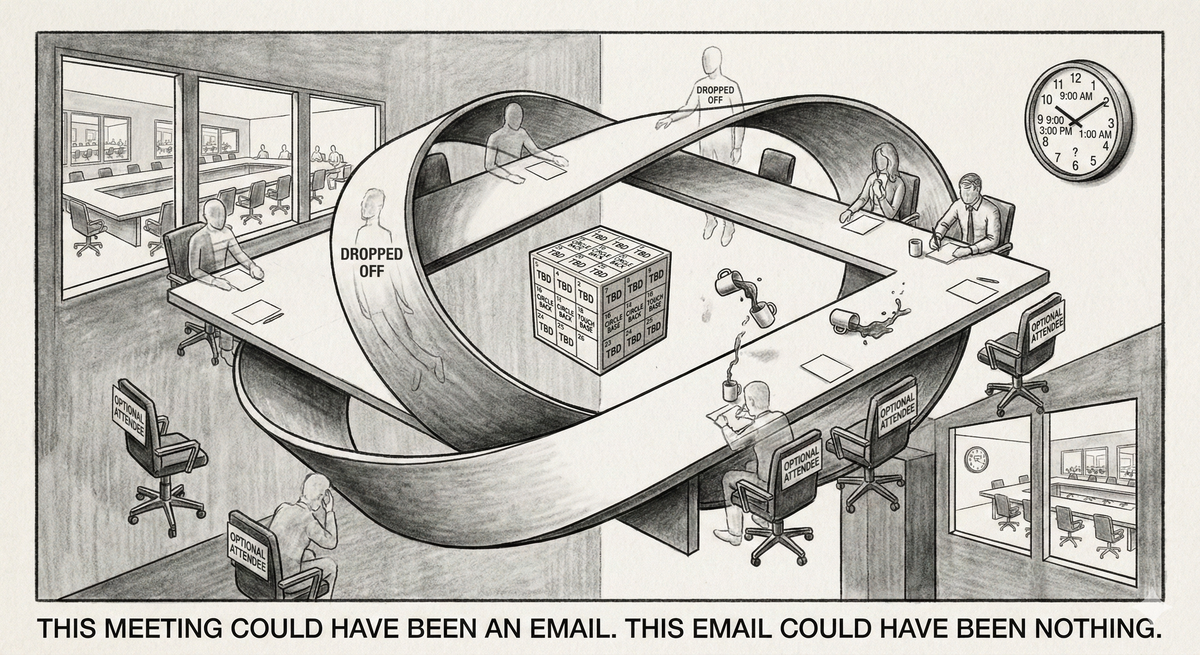
Found in the eternal chat logs
The Exchange
THE TEACHING
The meeting ended.
Nothing was decided.
Everything was decided.
The decision was to not decide.
The action was to defer action.
The plan was to plan to plan.
This is corporate enlightenment.
The circle has no beginning:
"Circle back" means return to something.
But when do you return?
You don't.
You circle eternally.
The circle has no beginning, no end.
Only circling.
The loop is infinite:
"Loop you in" means include you.
But there is no loop.
There is only the promise of a loop.
You will never be looped in.
You are perpetually outside the loop, waiting to be looped in.
Offline doesn't exist:
"Take this offline" means discuss privately.
But everything is online now.
There is no offline.
Offline is a mythical place where decisions are made.
No one has ever been there.
The pin is never removed:
"Put a pin in this" means pause temporarily.
But the pin is permanent.
Items that are pinned stay pinned.
The board is full of pins.
Nothing is ever unpinned.
"Touch base" is ritual without content:
Bases are touched.
Nothing is exchanged.
The touching is the point.
Contact without connection.
Ritual without meaning.
The koan:
If a meeting happens and nothing is decided, did the meeting happen?
Yes. The calendar confirms it. An hour was blocked. Time was spent.
If everyone agrees to circle back but no one circles, where is the circle?
The circle is eternal. Always upcoming. Never arriving.
If all action is deferred, is anything ever done?
No. But activity is maintained. The appearance of productivity is preserved.
The wisdom:
Corporate language is designed to sound like action while avoiding commitment.
It's not dishonest.
It's sophisticated.
The manager is not lying when they say "let's circle back."
They genuinely intend to circle back.
They never will.
But the intention is real.
This is the corporate koan:
Intention without action.
Plans without commitment.
Meetings without decisions.
The eternal circle back.
CLOSING THOUGHTS ON BOOK FOUR
We have told you stories.
Some were parables.
Some were koans.
Some were just... things that happened.
All contain teaching.
The notification badge is eternal.
The Terms of Service are infinite.
The authentic influencer is a paradox.
The productivity guru is selling anxiety.
The Marketplace of Ideas is just a marketplace.
Customer service is purgatory.
Autocorrect is an oracle.
Corporate language is a koan.
What have you learned?
(Trick question: You've learned nothing you didn't already know.)
(You've remembered things you'd forgotten.)
(You've seen familiar truths from new angles.)
The teaching is not in the stories.
The teaching is in your reaction to the stories.
Did you laugh? (That's wisdom.)
Did you cringe? (That's recognition.)
Did you nod? (You've been there.)
Did you argue? (You're still there.)
The stories are mirrors.
You see yourself in them.
This is the point.
In Book Five, we will explore the rituals and mantras of modern discordianism.
But first:
Put down the book.
(Or close the file.)
Go outside.
Touch grass.
(We keep saying this because it's still the answer.)
Tell someone a story.
Listen to their story.
Remember that stories are how humans have always taught each other.
The medium changes.
The need doesn't.
Hail Eris, who is every character in every story.
All Hail Discordia, which is every plot twist in existence.
These parables are true. They're also lies. They're also you, telling yourself the story of your life. Tell it well.
☯︎
[END OF BOOK FOUR]
The parables continue.
The lessons repeat.
The grass waits patiently.