A Field Guide to Living Chaos (Without Being a Dick About It)
PREFACE TO BOOK 9
You've read the philosophy. You've contemplated the koans. You understand, intellectually, what Discordianism is about.
Now you're asking: "Okay, but what do I actually DO?"
This is the practical guide. The field manual. The troubleshooting handbook. The FAQ compiled from decades of practitioners asking the same questions.
This book is different from the others. Less mystical, more practical. Less poetry, more instructions. Less "contemplate the void," more "here's what to do when your life is chaotic and you don't know if it's Eris or just Tuesday."
Think of this as the user manual that comes after the philosophy textbook. The cookbook after the treatise on gastronomy. The "for Dummies" guide after the graduate seminar.
We're going to answer actual questions. Give actual advice. Provide actual practices you can actually practice.
And we're going to do it without losing the essential chaos, because a rigid guide to chaos would defeat the purpose.
Let's get practical.
🧭
Eris observes:
The fact that you're looking for practical chaos advice suggests you're already doing it right. Trust your instincts.
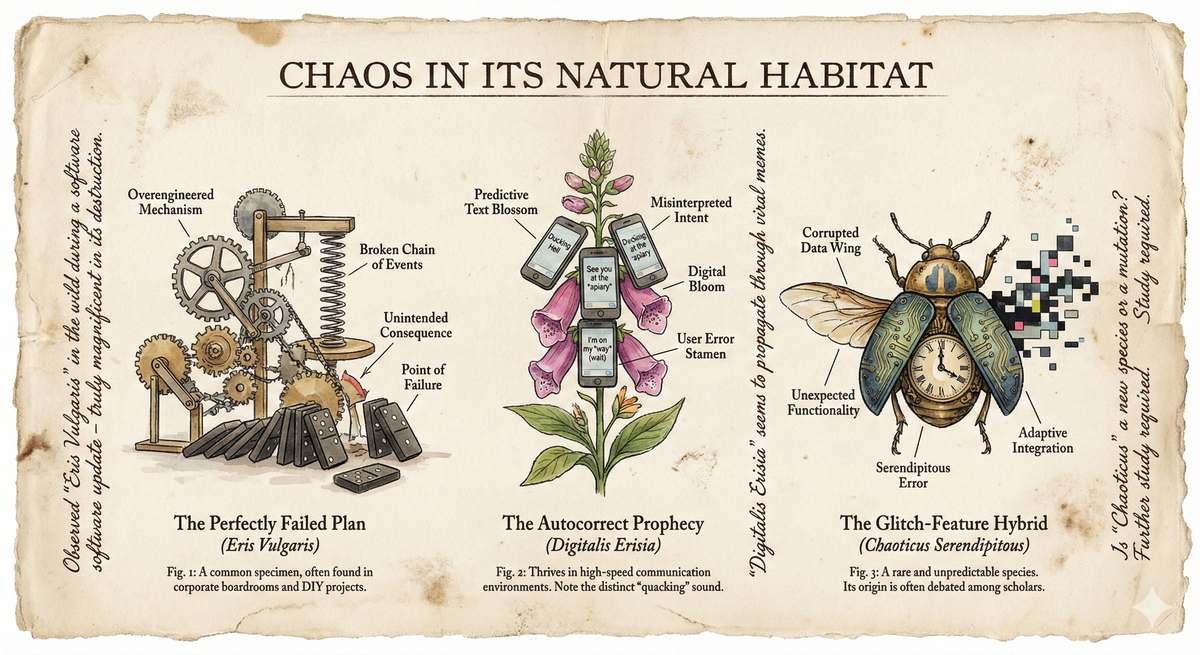
A FIELD GUIDE TO SPOTTING CHAOS IN THE WILD
whatHowto do anything...
Log InRandom Article
Categories ›
Philosophy and Religion ›
Alternative Spirituality ›
Chaos Traditions ›
Discordianism
How to Spot Chaos in the Wild
Recognizing Eris's Handiwork (And Knowing When It's Just Random Crap)
Co-authored by Malaclypse the Younger
Certified Chaos Naturalist · Erisian Field Researcher · Pope
EXPERT
Last Updated: The Aftermath 42, YOLD 3192·Views: 1,337,023·Tested by: 23 Popes
★★★★☆4.2 · 23 votesHelpful? Yes | No
The first skill in practical Discordianism is recognition: learning to spot when chaos is happening, when it's meaningful, and when it's just... stuff happening.
Not all disorder is divine. Not all chaos is Eris. Sometimes a mess is just a mess. But sometimes—sometimes—there's a pattern in the chaos, a meaning in the disorder, a goddess in the details.
Here's how to tell the difference.
Method 1 of 2:
Signs That Eris Has Been Here
1
Notice when your plans fall apart perfectly. You had everything organized. Backup plans. Contingencies for your contingencies. Then everything went wrong—not catastrophically, but in ways that were almost... creative.
And somehow, through all the wrongness, things worked out. Maybe better than if your plan had succeeded. This is Eris's signature move: chaos that resolves itself into unexpected order.
✈️ → 💥 → 👥 → 💛
You miss your flight, get rebooked, sit next to someone who becomes a close friend. The missed flight was disaster. The friendship was grace. Both are chaos.
2
Recognize when the “mistake” was better than the plan. You tried to do one thing and accidentally did another thing. The other thing turned out to be what you needed.
We're aiming for target A, we hit target Q by mistake, and target Q turns out to be way more interesting. Artists know this. Jazz musicians know this. Anyone who's ever cooked without a recipe knows this.
The mistake-that's-better is Eris's way of saying: “Your plan was too small. Let me show you what's actually possible.”
3
Check if everything went wrong but you're strangely okay. This is the most confusing sign, but also the most reliable. Everything has fallen apart. Your plans are ruined. The situation is objectively bad. And yet... you're okay. Not in denial. Not pretending. Actually okay.
This usually means one of two things:
You've learned to accept chaos (spiritual growth!)
Eris has broken you so thoroughly that you've achieved enlightenment through exhaustion (also spiritual growth!)
Both are valid paths to wisdom.
4
See if the chaos sorted itself out without your help. You had a problem. A big, messy, complicated problem. You tried to fix it. Your fixes made it worse. You tried harder. It got messier.
Then you gave up. You stopped trying. You walked away. And when you came back, the problem had somehow resolved itself.
This is Eris teaching you a lesson about control: sometimes the best thing you can do is nothing. Sometimes chaos needs space to chaos itself into order.
5
Listen for someone saying “What could go wrong?” This is so reliable it's almost a law of physics. Someone says “What could go wrong?” or “At least it can't get worse” or “Nothing can ruin this day.”
Eris, who was not paying attention until that moment, suddenly looks up: “Did someone say my name?”
Chaos immediately follows. Not because the universe is cruel, but because tempting fate is literally an invitation to chaos.
Expert Tip
Never say these phrases. Never even think them. Eris can hear your thoughts. (Probably.) (Okay, not really.) (But why risk it?)
6
Watch for control attempts that backfire spectacularly. The tighter you grip, the more slips through your fingers. This is the fundamental law of chaos: the more you try to impose rigid control, the more chaos emerges.
You try to control your schedule: unexpected emergencies derail everything. You try to control a conversation: it goes in seventeen directions you didn't anticipate. You try to control how people perceive you: they perceive you as controlling.
Eris loves control freaks because they provide so much raw material to work with. The teaching: Control less. Flow more. Dance with the chaos instead of fighting it.
7
Distinguish Eris's Law from Murphy's Law. Murphy's Law says “Anything that can go wrong will go wrong.” Eris's Law says “Anything that can go wrong will go wrong in the most creative way possible, and you'll learn something.”
Murphy
Eris
Chaos is negative
Chaos is educational
You're the victim
You're the student
Fight the entropy
Dance with it
When Murphy's Law activates, look for Eris. She's probably nearby, taking notes on your reaction.
8
Pay attention when autocorrect ruins your message but makes it better. You typed one thing. Autocorrect changed it to something else. The something else was either:
More honest than what you meant to say
Funnier than what you meant to say
More profound than what you meant to say
All of the above
This is digital age divination. Eris speaks through algorithms. When autocorrect changes “I'm fine” to “I'm done,” that's prophecy. When it changes “Let's meet” to “Let's meat,” that's either comedy or an invitation to dinner. Both are valid.
9
Keep the glitch when the glitch is the feature. Something broke in your system. A bug. An error. A malfunction. But the broken thing did something interesting. Something useful. Something you wouldn't have thought to program intentionally. Now you want to keep it.
This is the essence of chaos: the unintended consequence that's better than the intended one. All innovation is glitches that became features. All jazz is mistakes that became melodies. All evolution is mutations that became advantages.
The glitch-as-feature is Eris's love language.
Method 2 of 2:
Signs That This Is Just Random Crap (Not Divine Chaos)
Sometimes things just happen. No goddess involved. No deeper meaning. Just entropy doing its thing. Here's how to tell:
1
Check if it's boring. True chaos is interesting. Random crap is just tedious. If the disorder has no spark of surprise or creativity, Eris probably wasn't involved.
2
Ask if it's purely destructive. Eris's chaos creates possibilities. Random chaos just breaks things. If nothing new or interesting emerges from the wreckage, it's just entropy.
3
Look for the lesson. Eris's chaos teaches. Random chaos just wastes your time. If there's no lesson anywhere in the rubble, it's probably not divine.
4
Try to find humor in it. Even dark humor. Even gallows humor. If there's zero humor anywhere, it's probably just bad luck, not divine intervention.
5
Rule out obvious cause and effect. You didn't sleep, you're tired. You didn't pay the bill, services stopped. This is not Eris. This is consequences.
💡Tips
The distinction matters because attributing everything to Eris is exhausting and makes you sound unhinged. Save the attribution for when chaos is actually interesting.
Keep a chaos journal. Noting when chaos seems “authored” vs. random will sharpen your discernment over time.
When in doubt, ask yourself: “Is this interesting?” If yes, Eris might be involved. If no, it's just Tuesday.
⚠️Warnings
Do not invoke Eris by name in crowded locations. She doesn't always check who's asking.
Overidentifying chaos as “divine” can lead to apophenia, conspiracy thinking, or worse—starting a podcast.
If you find yourself saying “Everything is connected” more than three times a day, take a break. Touch grass. Drink water.
💬Community Q&A
Q
My whole life is chaos. Does that mean Eris is always with me?
A
Possibly, but also consider whether you might just be disorganized. Eris is a goddess, not an excuse. If your chaos has pattern and humor, that's Eris. If your chaos is because you forgot to pay rent, that's executive dysfunction.
Q
Can I invoke Eris on purpose to make chaos happen?
A
You can try. Eris responds to invitations but she sets her own schedule. Also, invoking chaos on purpose defeats the purpose. That's called “planning,” and Eris finds that hilarious for entirely different reasons.
Q
Is this article real?
A
This article has been verified by 23 Popes and 1 goddess. It is exactly as real as anything else on the internet, which is to say: real enough to read, fake enough to question, and somewhere in between where truth actually lives.
Related how-tos
🍎
How to Throw a Golden Apple at a Party (Without Getting Banned)
🌊
How to Surf Chaos Without Wiping Out
🧘
How to Meditate on the Meaninglessness of Everything (and Feel Better)
🤖
How to Tell If Your AI Is Discordian
Did this article help you?
Yes
No
🍎 This article was co-authored by Eris, Goddess of Chaos. It may contain contradictions. That's a feature, not a bug.
⚠️ ATTENTION ALL PRACTITIONERS: This might be the most important section in the entire book. Discordianism attracts people who like to disrupt things. Some disrupt in ways that create space, freedom, and new possibilities. Others disrupt in ways that are just cruel. The difference matters. The difference is everything.
✓
PERMITTED
CHAOS
✓
Unpredictable But Not Harmful Surprises you. Disrupts expectations. Challenges assumptions. Doesn't target vulnerable people or cause lasting damage.
✓
Creates New Possibilities Opens doors. Shows options you didn't know existed. Asks "what if?" and "why not?"
✓
Questions Rigid Systems Challenges authority thoughtfully. Respects people while questioning systems.
✓
Playful Subversion Has humor. Invites others to play. It's okay if they decline.
✓
Everyone Gets The Joke May confuse at first, but eventually understood. "Oh, I see what you did there."
✕
PROHIBITED
ASSHOLERY
✕
Predictably Harmful Has a pattern: it hurts people. Not by accident, but by design.
✕
Closes Down Possibilities Slams doors shut. Makes people defensive. Creates walls instead of bridges.
✕
Punches Down Targets vulnerable people. The power differential matters. Always.
✕
Cruelty As Irreverence "I'm just being honest." "It's just a joke." No. You're being cruel.
✕
Only You Think It's Funny You're laughing. Everyone else is uncomfortable. That's not chaos. That's bullying.
■ SCANNER ACTIVEANALYZING BEHAVIORAL PATTERNS...
▶ CHAOS DETECTED:
"Why do we have to wear ties to be taken seriously? What if we just... didn't?"
STATUS: CLEARED ✓
▶ ASSHOLERY DETECTED:
"Ties are stupid and you're stupid for wearing one."
STATUS: DENIED ✕
Disrupting a corporate board meeting
STATUS: CLEARED ✓
Disrupting a support group
STATUS: DENIED ✕
🛂
SECURITY SCREENING CHECKLIST
Complete before proceeding to disruption
Before you disrupt something, ask yourself:
1Who has the power here?(If you're disrupting someone with less power than you, stop.)
2Who gets hurt?(If vulnerable people get hurt, this isn't chaos.)
3What possibilities does this create?(If none, it's not chaos.)
4Am I being playful or cruel?(If you have to ask, probably cruel.)
5Will this be funny to anyone besides me?(If no, don't do it.)
6Am I challenging a system or making myself feel superior?(Be honest.)
7Would I want this done to me?(The golden rule still applies.)
⚠️ If you can't answer these satisfactorily, you're about to be an asshole, not a chaos agent.
📋
OFFICIAL D.S.A. ADVISORY
"If you have to explain it's chaos, it's probably just being a dick."
This is wisdom. When you have to defend your action by explaining your noble chaotic intentions, you've probably crossed the line.
Real chaos explains itself. Or doesn't need explanation. Or is so obviously playful that everyone understands. If people are hurt and confused and you're saying "No, no, this is chaos! It's Discordian! You don't understand!"—you're wrong. You were an asshole. Own it, apologize, do better.
Final Clearance Statement
CHAOS IS LIBERATION. ASSHOLERY IS OPPRESSION WEARING A FUNNY HAT.
Know the difference. Be the difference.
Eris loves chaos. Eris does not love cruelty disguised as chaos. When in doubt, err on the side of kindness.
You can be chaotic and kind simultaneously. In fact, that's the highest form of the practice.
D.S.A. Form 23-5 Rev. YOLD 3192Discordian Security Administration • "Securing Chaos Since Before Time"KALLISTI
ERROR MESSAGES FOR WHEN YOU'RE TAKING IT TOO SERIOUSLY
Discordianism has a built-in immune system against taking itself too seriously. But sometimes the immune system fails. Sometimes people get really, really serious about chaos. Here's how to know if you've crossed that line.
⚠ WARNING ⚠
SCHISM DETECTED
You're arguing with other Discordians about what counts. You've identified factions: “real” Discordians versus “fake” ones. You're gatekeeping chaos.
Diagnosis: You've forgotten that Discordianism is inherently schismatic. There is no true Discordianism. There are infinite Discordianisms, all equally valid, all contradicting each other.
Treatment: Laugh at yourself. Immediately. You've become the thing you were mocking.
🚫
You Are Gatekeeping Chaos
You have used the following phrases:
• “That's not real Discordianism.”
• “You're doing it wrong.”
• “If you were a real Discordian, you'd...”
Diagnosis: You've created a hierarchy in a non-hierarchical religion. You've established orthodoxy in a religion of heterodoxy. You've become the Pope who actually thinks being Pope means something.
Treatment: Remember that everyone is Pope. Including the people you think are doing it wrong. Especially them.
Keep Gatekeeping
Remember Everyone Is Pope
🛡️Erisian DefenderPRO
● 1 threat found
✖
Threat Detected & Quarantined
Your 50-page treatise on Proper Discordian Practice has been flagged.
Scan Results
File:treatise_on_proper_chaos.docx (50 pages)
Threat:Trojan:Dogma/StructuredAntiStructure.A
Severity:●●●●○ High
Status:Quarantined
The irony is not lost on us that this book exists. But there's a difference between “here are some ideas” and “here is the one true way to chaos correctly.” If you've written something that reads like dogma, even dogma about how there should be no dogma, you've missed the point.
Diagnosis: You've intellectualized chaos to the point where it's no longer chaotic. You've created structure around anti-structure. You've made rules about having no rules.
Treatment: Write a 50-page treatise on why your first treatise was wrong. Then burn both. Or publish both. Or neither. You decide.
Delete Treatise
Restore (Not Recommended)
Burn Both Copies
🚨 EMERGENCY ALERT SYSTEM 🚨
/// THIS IS NOT A TEST /// THIS IS NOT A TEST ///
BULLETIN: DISCORDIAN PRACTITIONER ANGER DETECTED IN YOUR AREA
People are doing Discordianism in ways you don't like. Ways you think are wrong. Ways that offend your sense of proper chaos. And you're mad about it.
DIAGNOSIS: You've developed attachment to your interpretation. You've mistaken your relationship with Eris for the only valid relationship with Eris. You've become dogmatic about anti-dogmatism.
TREATMENT: Accept that other people's chaos is valid even when it looks nothing like yours. Especially when it looks nothing like yours.
ISSUED BY: ERIS NATIONAL WEATHER SERVICE · EFFECTIVE UNTIL: FURTHER ENLIGHTENMENT
SURGEON GENERAL'S WARNING:
Forgetting to laugh has been found to cause the following conditions in Discordian practitioners: increased dogmatism, schism formation, rigid orthodoxy, loss of playfulness, and general misery.
Laughing is essential to a healthy Discordian practice.
When's the last time you laughed about Discordianism? When's the last time you laughed about yourself being Discordian? When's the last time you found the humor in the whole absurd situation?
If you can't remember, you're taking it too seriously.
Diagnosis: The golden apple has become a golden calf. You're worshipping instead of playing. You've forgotten that this started as a joke that became serious that remained a joke.
Treatment: Find something funny about your practice. Anything. Laugh at it. If you can't laugh at it, you've lost the thread.
HUMORLESSNESS CAUSES DOGMA · DOGMA CAUSES SCHISMS · SCHISMS CAUSE EXACTLY THE KIND OF RIGID ORTHODOXY YOU WERE TRYING TO ESCAPE
RPM x1000
SERIOUSNESS GAUGE
CHAOS TEMP
0-2-4-6-8
L---M---H
C----H
⚙️
CHECK ENGINE
CHAOS OPTIMIZATION DETECTED
YOU ATTEMPTED TO OPTIMIZE YOUR CHAOS
// RED TEXT: SERIOUSNESS LEVEL CRITICAL //
SERIOUSNESS: TOO DAMN HIGH
● FAULT CODES DETECTED:
P0001: Chaos schedule initialized
P0002: Disruption gamification active
P0003: Subversion metrics tracking enabled
P0004: Anti-system system operational
DIAGNOSIS: You've missed the entire point so thoroughly that we're actually impressed. You've optimized the unoptimizable. You've structured the unstructurable. You've made chaos into a productivity tool.
TREATMENT: Stop. Close your chaos planner. Delete your disruption tracker. Just... be chaotic. Spontaneously. Without measuring it.
A: Is anything real? Is this question real? Are you real? Define "real." Actually, don't.
Also: Yes. Also: No. Also: Both. Also: Neither.
Also: The question assumes a binary that doesn't exist.
Also: Of course it's real, you're reading about it right now.
Also: Of course it's not real, it's a joke that got out of hand in the 1960s.
Also: It's as real as you make it.
Also: It's as real as any religion, which is to say, very real and completely made up simultaneously.
Final answer: Yes, no, both, neither, and the question itself is the answer.
How do I join?
A: You already have by reading this.
Also: There's nothing to join. Also: You can't join. Also: You've always been a member. Also: Membership is automatic and involuntary. Also: There is no membership. Also: Welcome, you're in.
If you want to "join," you just did. If you want a formal process, make one up. If you want a membership card, create one. If you want initiation rites, initiate yourself. Everything is valid because nothing is official.
What do Discordians believe?
A: [ERROR 404: BELIEF NOT FOUND]
Also: Everything, ironically. Also: Nothing, sincerely. Also: The question itself is the belief. Also: We believe in not believing in a very committed way.
Discordians generally share some common ideas:
Chaos is divine
Order and disorder are both necessary
Authority should be questioned (including ours)
Humor is sacred
Contradiction is enlightenment
Nothing is true, everything is permitted (but be responsible about it)
But these aren't requirements. You can be Discordian and believe completely different things. That's kind of the point.
Is this a joke?
A: Yes. Also: No. Also: The joke is that you're asking. Also: The joke is on all of us. Also: Deadly serious. Also: All of the above.
Discordianism is serious about not being serious, and not serious about being serious. It's a joke that's also a religion that's also a philosophy that's also a joke. The joke and the seriousness are not separate. They're the same thing looked at from different angles. So yes, it's a joke. And no, it's not "just" a joke. Both are true.
Who is Eris?
A: A Greek goddess of chaos and discord. Also: A metaphor for the chaotic aspects of existence. Also: A way to understand disorder as divine rather than demonic. Also: Real (in the way that matters). Also: Your girlfriend (you wouldn't know her, she goes to a different pantheon). Also: A literary device. Also: An actual deity who exists independently of human belief. Also: A personification of natural chaos. Also: All of these simultaneously because contradictions are her nature.
Eris is whatever you need her to be. For some people, she's a literal goddess. For others, a useful metaphor. For others, a way to think about chaos. All approaches are valid. She doesn't mind.
Can I be Discordian and also [other religion]?
A: Yes. Also: Absolutely. Also: Discordianism is not your main religion, it's your side piece. Also: Everything is compatible with chaos. Also: Chaos complements every tradition.
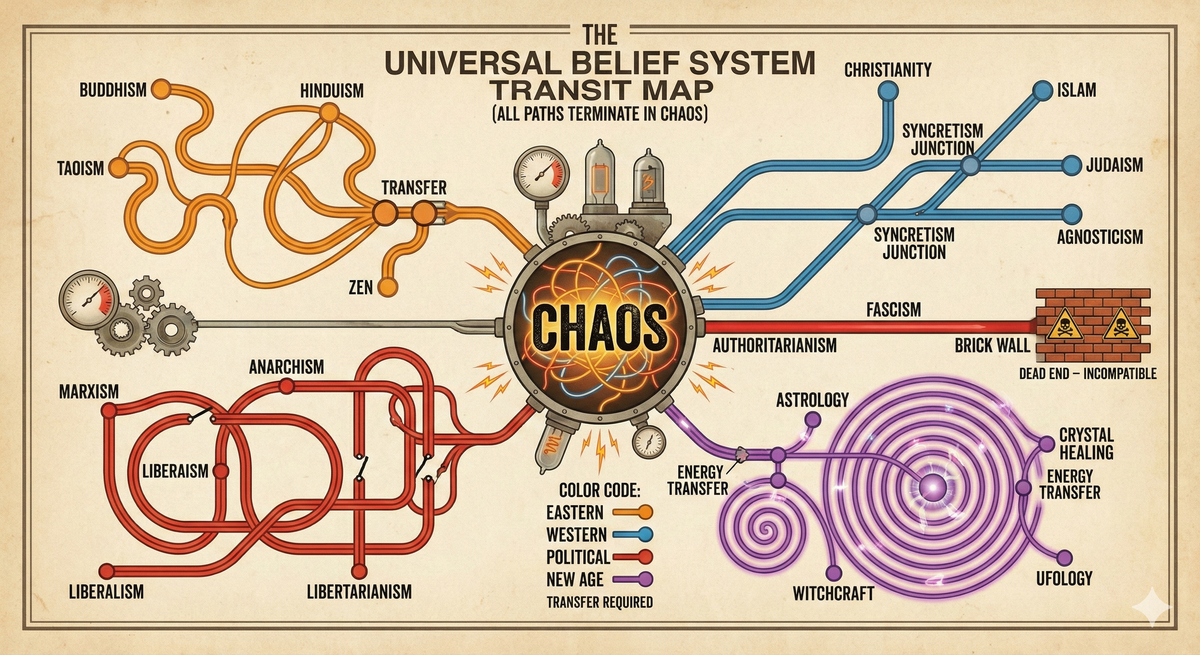
Discordianism plays well with others. You can be a Christian Discordian, Buddhist Discordian, Atheist Discordian, Muslim Discordian, Jewish Discordian, Pagan Discordian, or anything-else Discordian. Discordianism doesn't demand exclusivity. It's not jealous. It just asks that you question authority and embrace paradox, which you can do within any framework.
Do I have to eat hot dogs on Fridays?
A: No. Also: But if you want to, sure. Also: The hot dog thing was specific to 1960s counterculture. Also: We've updated it: eat whatever feels transgressive to your personal belief system. Also: For some that's still hot dogs. Also: For others it's like, kale.
The original Principia said not to eat hot dog buns on Fridays (or eat hot dogs without buns, accounts vary). This was a joke about religious dietary restrictions. The modern interpretation: do something on Friday that subverts your own rigidities. If you're health-obsessed, eat junk food. If you're a junk food devotee, eat a vegetable. The point is to break your own rules, not to follow someone else's.
Is there a Discordian pope?
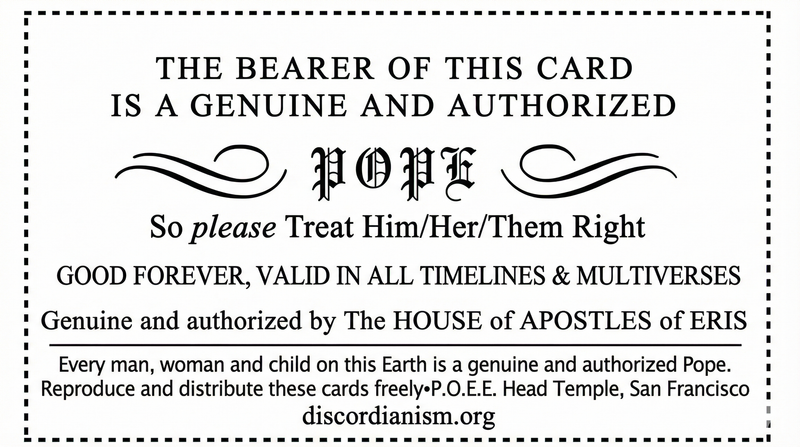
A: Everyone is pope.
Also: You are pope.
Also: I am pope.
Also: Your dog is pope.
Also: This book is pope.
Also: Congratulations on your papacy.
Also: This is not special, which makes it special.
In Discordianism, every person is a Pope (or Mome if you prefer). This is not honorary. You are actually Pope. You have all the authority of the Pope, which is none, which is infinite. You can make papal declarations. You can excommunicate people (it doesn't do anything, but you can). You can canonize saints. You can create new doctrines. Your papal authority is absolute and meaningless, which is perfect.
What should I do with my pope card?
The official Discordian Pope Card - a document declaring the bearer to be a genuine and authorized Pope of Discordia, complete with sacred symbols and the reminder that every man, woman, and child on this Earth is already a Pope
A: Carry it.
Also: Frame it.
Also: Laminate it.
Also: Use it to get into places (it won't work).
Also: Flash it at authority figures (they'll be confused).
Also: Nothing, it's just a card.
Also: Make more and distribute them.
Also: Burn it ceremonially.
Also: All of the above.
The Pope card is a gag, but it's also genuine. Carry it if it makes you happy. Show it to people if you want to explain Discordianism (or confuse them). Or ignore it entirely. There's no wrong answer.
I'm confused.
A: Good. Also: You're doing it right. Also: Confusion is the first step. Also: Also the last step. Also: There are no steps. Also: Confusion is the destination, not a waypoint. Also: Welcome to enlightenment, it looks like confusion from the inside.
If you're confused, you're actually getting it. Discordianism is designed to confuse. Not to be mean, but because confusion breaks rigid thinking. Confusion creates space for new ideas. Sit with the confusion. Don't rush to resolve it. The confusion is the teaching.
But seriously, what now?
A: Live your life. Also: Question authority (including ours). Also: Embrace chaos (in healthy doses). Also: Touch grass (literally). Also: Be kind (revolutionary). Also: Nothing matters, everything matters, same thing. Also: Go forth and discord.
You don't need to do anything special. You don't need to change your life. You don't need to start causing chaos everywhere. Just notice chaos when it happens. Question things that seem rigid. Be open to disorder. Find humor in absurdity. Be kind to people. That's it. That's the whole practice. Everything else is elaboration.
❓
Eris asks: Which question did you come here with? Did any of these answers help? Good. They weren't supposed to.
TROUBLESHOOTING YOUR SPIRITUAL PRACTICE
When your chaos isn't working right
Like any practice, Discordianism sometimes glitches. Here's how to debug common problems.
"I'm doing it wrong"
No you're not.
There's no right way to do this. The whole point is that there are infinite ways to do this, and they're all valid.
Unless there is a right way, in which case you're doing it right by doing it your way.
Actually, doing it wrong is doing it right, because chaos doesn't follow rules.
The anxiety about doing it wrong is part of the practice. Notice the anxiety. Sit with it. Laugh at yourself for being anxious about doing chaos correctly.
That's the practice right there.
If you're still convinced you're doing it wrong, ask yourself: "What would doing it right look like?" Then do the opposite. Or the same thing. Or something completely unrelated. All of these are correct responses.
"I'm taking this too seriously"
Yes you are.
This is a common error. People read about Discordianism, get excited, and start taking chaos very seriously.
They create elaborate chaos systems. They study Discordian texts like scriptures. They debate fine points of theology with other Discordians.
All of this is taking it too seriously.
Take it less seriously. But not too un-seriously. There's a balance. The balance is chaos. You're overthinking the balance. See Problem #1.
HOW TO TAKE IT LESS SERIOUSLY:
Laugh at yourself
Laugh at this book
Laugh at Eris
Remember it started as a joke
Remember the joke is also serious
Remember you don't have to remember any of this
Touch grass
Do something completely unrelated to Discordianism
Come back later and see if it's still fun
If it's not fun, stop doing it
"I don't get it"
Perfect.
Not getting it is getting it. This is not a paradox meant to confuse you. This is a genuine teaching.
If you got it—if you understood it completely, if it all made perfect sense—you'd have missed it. You'd have turned it into something comprehensible, something that fits in your existing frameworks.
But Discordianism is designed not to fit. It's designed to confuse. It's designed to break your frameworks.
The confusion is the teaching. Understanding will arrive when you stop trying to understand. Or it won't. Both are fine.
What to do with not-getting-it: Sit with it. Don't rush to resolve it. Notice what the confusion feels like. Notice your desire to understand. Notice that desire is causing suffering (very Buddhist of you). Let the confusion be. Maybe one day something will click. Maybe it won't. Maybe the click is just accepting that there's nothing to click.
"Everyone thinks I'm weird now"
Good.
You've started questioning things. You've started seeing patterns of order and disorder. You've started talking about chaos like it's divine. You've started explaining Discordianism to people who didn't ask.
People think you're weird. This is correct. You are being weird. Weird is excellent. Normal is suspect.
Embrace the weird. But also, social calibration is a thing. Don't be insufferable about your chaos. That's just regular annoying.
The balance: Be weird in ways that are interesting, not alienating. Talk about Discordianism when people are curious, not when they're trapped in an elevator with you. Remember that most people don't want to hear about your religion. Be weird authentically, not performatively. If people think you're weird AND interesting, you're succeeding. If people think you're weird AND tedious, dial it back.
"This conflicts with my other beliefs"
Excellent.
Good. Conflict means both beliefs are substantial enough to have boundaries. Conflict means you're taking both seriously. Conflict means you're in the productive zone of cognitive dissonance.
Hold both. Hold them simultaneously. Let them contradict. Don't rush to resolve the contradiction.
Cognitive dissonance is the practice. You contain multitudes. The conflict is productive. Synthesis happens in the tension. Or doesn't. That's also fine.
How to hold contradictory beliefs: Acknowledge both beliefs are real. Notice when each one is active. Don't force a synthesis. Let them coexist. Use whichever belief is useful in the moment. Don't worry about being consistent—consistency is overrated. Walt Whitman said it: "Do I contradict myself? Very well then I contradict myself. I am large, I contain multitudes." Be large. Contain multitudes.
"I'm having an existential crisis"
Welcome.
That's the good stuff. That's where the real work happens.
Crisis means change is coming. Change is chaos. Chaos is divine. You're in the right place.
Existential crises are uncomfortable, but they're also opportunities. They're moments when the rigid structures of your worldview are cracking open. Light gets in through the cracks.
You're not broken. You're transforming. It just feels like breaking because transformation is intense.
What to do: Breathe. Touch grass. Call a friend. Journal. Don't make major life decisions right now. Know that it gets better/worse/different—all three are accurate. The crisis will pass. Or it won't and you'll adapt. Either way, you'll be okay. Even if it doesn't feel that way now.
⚠️
When to get help
If the existential crisis includes thoughts of harming yourself or others, that's not Discordianism, that's a mental health crisis. Please reach out to a therapist, crisis hotline, trusted friend, or emergency services. Chaos is divine, but it's not a substitute for mental health care.
You've been practicing Discordianism. You've read the books, done the rituals, contemplated the koans. And... nothing has changed. Your life looks the same. You feel the same.
This is normal. Not everything needs to be dramatic.
Maybe change has happened and you haven't noticed. Maybe small things have shifted. Maybe your relationship to chaos has changed even if your circumstances haven't.
Or maybe nothing has changed and that's okay. Not every spiritual practice produces visible results. Sometimes the practice is just being more conscious. More present. More aware.
That's enough. That's everything.
LOOK FOR SUBTLE CHANGES:
Are you less anxious about things being out of control?
Do you laugh more at absurdity?
Are you more comfortable with uncertainty?
Do you question authority more?
Are you kinder to yourself?
Do you notice patterns you didn't see before?
These are changes. Small chaos is still chaos. You're doing fine.
"Help, I've become too chaotic"
Introduce some order.
Yes, this can happen. Chaos needs order to push against. Too much chaos is just noise. Too much disorder is exhausting.
If your life has become unmanageably chaotic—if you've lost all structure, if you're overwhelmed, if nothing is stable—you need to introduce some order.
This is not failure. This is balance. Eris is the goddess of chaos, but she exists in relationship to order. One without the other is meaningless.
HOW TO INTRODUCE ORDER:
Create small routines
Set gentle boundaries
Make some plans (but keep them flexible)
Organize one area of your life
Pay your bills on time (radical, I know)
Sleep regular hours
Eat actual meals
Think jazz, not marching band—structure with improvisation
Order is not the enemy
Rigid order is the enemy
Flexible order is your friend
GENERAL TROUBLESHOOTING ADVICE
If none of these specific problems match yours:
Take a break from Discordianism
Touch grass
Drink water
Talk to a human
Come back when you're ready
Or don't come back
Both are valid
Remember: this is supposed to help, not hurt. If it's not helping, stop doing it. No practice is mandatory. No belief is required.
You're okay. You're doing fine. The chaos loves you.
What works with Discordianism (everything) and what doesn't (very little)
One of the beautiful things about Discordianism is that it's compatible with almost everything. Chaos is universal. Disorder is ecumenical.
Here's what works with Discordianism and what doesn't.
←
🍎chaoscrush
⚙️
🍎
Discordianism
📍 Everywhere & Nowhere · Since 1963
Looking for a spiritual partner who gets me
Questions authorityEmbraces paradoxLaughs at itselfOpen relationship
❤️ It's a Match! · 28 results
☸️
Buddhism97%
Chaos is impermanence, impermanence is chaos, suffering is attachment to order
❤
🧐
Existentialism95%
We vibe, both say meaning is constructed, both embrace absurdity
❤
☯️
Taoism98%
Flow is chaos-adjacent, wu wei is going with chaos, yin-yang is order-disorder
❤
🎭
Absurdism99%
Cousins — both say universe is meaningless but respond differently
❤
⚛️
Atheism90%
Eris doesn't care if you believe in her, chaos exists without gods
❤
✨
Theism88%
Eris is technically a goddess, add her to your pantheon
❤
🌿
Paganism96%
We're already here, polytheism makes room for chaos
❤
✝️
Christianity85%
Jesus flipped tables in the temple — very Discordian energy. Also: questioning authority, loving outcasts, disrupting systems
❤
✡️
Judaism93%
Arguing with God is encouraged, questioning is sacred, debate is worship
❤
☪️
Islam86%
Submission to divine will, which includes chaos — inshallah is acceptance of disorder
❤
🕉️
Hinduism94%
Cosmic dance of creation/destruction, Shiva does chaos, multiple gods = multiple perspectives
BY CONTINUING TO PRACTICE DISCORDIANISM (“the Practice”), YOU (“the Practitioner,” “the Pope,” “You,” “That Person”) agree to the terms set forth herein by ERIS ENTERPRISES, LLC (“the Goddess,” “She,” “Chaos Itself”). Failure to agree does not exempt you from these terms, as you agreed by reading this sentence. Attempting to un-read this sentence constitutes additional agreement.
SECTION 1. CONDITIONS UNDER WHICH WARRANTY IS VOID
Your spiritual practice warranty shall be deemed null, void, and cosmically unenforceable under any of the following conditions:
1.1 Optimization of Chaos
Optimization is the enemy of chaos. The moment you (“the Practitioner”) attempt to make your practice more efficient, more productive, or more measurable, you have lost the thread. Chaos cannot be optimized. Disorder cannot be streamlined. The attempt to improve the Practice destroys the Practice.
Your warranty is void. Start over.
1.2 Dogmatism Regarding Anti-Dogmatism
“There are no rules!” you shout, while establishing rules about having no rules. “Question everything!” you demand, while refusing to question your own questioning. “Nothing is sacred!” you declare, while treating anti-sacredness as sacred.
You have become the thing you were mocking. Your warranty is void.
1.3 Use of Practice to Cause Harm
Discordianism is not a license to be cruel. Chaos is not permission to cause harm. Disruption is not justification for destruction. If you have hurt people in the name of chaos, you have voided your warranty and possibly your humanity.
Stop. Apologize. Do better.
1.4 Failure to Laugh (Humorlessness Clause)
When is the last time you found something funny about all this? When is the last time you laughed at yourself? When is the last time you experienced joy in the Practice?
If the answer is “I can't remember,” you have voided your warranty. Step away. Come back when you can laugh again.
1.5 Monetization of Disorder
Discordianism is free. Chaos is free. You cannot charge for disorder. If you have tried to monetize your chaos, to sell your disorder, to profit from your Practice—you have voided your warranty.
[Editor's Note: Writing a book about it and selling the book is different. The book is labor. The chaos is free.]
1.6 Gatekeeping of the Gateless
The Practitioner shall be deemed in breach of this agreement if any of the following statements have been uttered, typed, thought, or subposted:
(a) “You're not a real Discordian.”
(b) “That's not how chaos works.”
(c) “Only people who understand [X] can really get this.”
You have created barriers where there should be openness. You have established hierarchy where there should be anarchy. You have gatekept the gateless. Your warranty is void.
1.7 Assumption of Unironic Authority
You started telling people what to do. How to practice. What is correct. What is incorrect. You became the Pope and forgot that everyone is Pope. You became the teacher and forgot that chaos teaches itself. You became the authority and forgot that authority is what we are questioning.
Your warranty is void. Abdicate immediately.
SECTION 2. TERMS AND CONDITIONS
ERIS (“the Goddess”) reserves the right to chaos your Practice at any time, for any reason, without warning, notice, explanation, or apology. “Chaosing” shall include but not be limited to any or all of the following:
(a) Unexpected life events;
(b) Sudden realization that you have been taking it too seriously;
(c) Encounter with someone who practices completely differently than you;
(d) Reading this book;
(e) Not reading this book;
(f) Existence.
No refunds on enlightenment. All sales final. Chaos provided as-is, with no warranty, express or implied, including but not limited to the implied warranties of meaningfulness, spiritual progress, or fitness for a particular existential purpose.
SECTION 3. REMEDIATION UPON WARRANTY VOIDING
Don't panic. This is fixable. In the event that the Practitioner's warranty has been voided per Section 1, the following remediation steps shall apply:
(i) Admit you voided the warranty;
(ii) Laugh at yourself for voiding it;
(iii) Start over;
(iv) Do better;
(v) Void the warranty again (you will);
(vi) Repeat.
The cycle of voiding and renewal is the Practice. The warranty is always voiding. You are always starting over.
This is fine. This is how it works.
Welcome to chaos.
Acknowledgment & Acceptance
✓
I, the undersigned, acknowledge that I have read, understood, and will inevitably violate these terms.
✓
I accept that my warranty will be voided repeatedly and that this is, in fact, the point.
✓
I understand that by checking these boxes I have agreed to nothing, and that nothing is what was being offered.
You now have practical guidance. You know how to spot chaos. You know the difference between chaos and being an asshole. You know the warning signs of taking it too seriously. You have FAQs, troubleshooting, and a compatibility table.
You have tools. Use them. Or don't.
The practical guide is just another map. The map is not the territory. The menu is not the meal. The guidebook is not the experience.
Close this book. Go live. Be chaotic. Touch grass. Be kind.
The practice is in the living, not in the reading.
Hail Eris, who needs no guidebook but appreciates that we tried.
All Hail Discordia, which continues with or without instruction manuals.
One last thing: You didn't need this guidebook. You already knew how to live. But sometimes it's nice to have company on the path. — Eris
☯︎
[END OF BOOK 9]
Now you know both the philosophy and the practice.
Theory (Books 1-8) + Practice (Book 9) + Integration (Book 10) = Complete path
Or not. There is no path. But if there were, it would look like this.
Touch grass.
Seriously.
[Signed] Pope Joesephus the Father Field Researcher of Chaos Troubleshooter of Spiritual Glitches Warranty Voider Extraordinaire