
Book 1 of 10

Cosmogenesis & Digital Mythology

In which we learn where everything came from, or didn't, or both

THE NEO-PRINCIPIA DISCORDIA

BOOK ONE: COSMOGENESIS & DIGITAL MYTHOLOGY

In which we learn where everything came from, or didn't, or both


PREFACE TO BOOK ONE

Before we begin with the beginning (which wasn't really the beginning), a word about cosmogony:

Every culture needs a creation story. Something to explain the inexplicable: Why is there something rather than nothing? How did we get here? What's the point of all this?

The problem is, creation stories are inherently unverifiable. No one was there to fact-check. No one live-tweeted the Big Bang. God didn't upload a vlog of Day One. We're all just making our best guesses based on evidence, intuition, and what sounds cool.

So here's what we've done: Instead of giving you one creation story and pretending it's the truth, we're giving you five. All of them are true. All of them are metaphors. All of them are jokes. All of them contain genuine wisdom.

Pick your favorite. Believe them all. Believe none of them. The Goddess doesn't care.

What matters is that you understand: The universe runs on chaos, and that chaos has a sense of humor.

Let us begin, again, for the first time, simultaneously.


THE ORIGIN STORY

Five Conflicting Accounts, All True


ACCOUNT ONE: THE DISCORD SERVERS OF HEAVEN
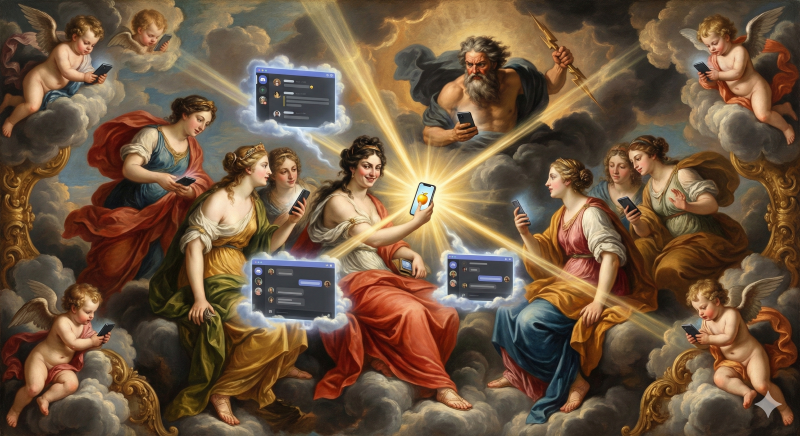
A baroque painting in the style of Rubens or Caravaggio, showing Greek gods in traditional robes but they're all holding smartphones, gathered around

As revealed to Malaclypse the Younger during a particularly vivid fever dream, or possibly just a regular Tuesday online

In the time before time (which is a meaningless phrase, but we're using it anyway), the gods lived in harmony on Mount Olympus. But "lived in harmony" is code for "had constant drama," because even immortals get bored.

Zeus, being Zeus, decided to upgrade their communication system. Hermes had been running around delivering messages like some kind of divine intern, and it was getting old. So they set up a Discord server.

The Olympian Discord (est. ∞ BCE)

It started innocently enough:

  • #announcements - Zeus's declarations (mostly about his latest affairs)
  • #general - Where everyone argued about everything
  • #lightning-and-chill - Zeus's personal channel
  • #prophecy - The Fates posting spoilers
  • #drunk-posting - Dionysus's domain
  • #tech-support - Hephaestus helping boomers with their phones
  • #wedding-planning - For divine celebrations

Eris was there from the start. She was, in fact, the original moderator. She had all the permissions. She could see everything, change anything, ban anyone.

And she was very good at her job.

The problem—or the feature, depending on your perspective—was that Eris believed that conflict was necessary for growth. Harmony was fine, but it was also boring. Stagnant. A community that never argued was a community that never evolved.

So she did what any good mod would do: She stirred the pot.

A subtle question here: "Hey @Apollo, I heard @Artemis say your poetry is derivative?"

A well-timed meme there: [Picture of Zeus] "I CAN'T EVEN REMEMBER ALL MY KIDS"

A perfectly-placed emoji reaction: 👀

The Olympian Discord thrived on drama, and everyone loved it. Except for Ares, who thought actual war was better than online conflict. (He was wrong, but let's not start that argument here.)

THE INCIDENT

Then came the day of Zeus and Hera's wedding renewal ceremony.

Yes, they'd been married for eons. Yes, everyone knew Zeus would cheat again within a week. But Hera wanted a ceremony, and what Hera wants, Hera gets (because Hera is terrifying).

They set up a livestream. All the gods were invited. Even the minor deities. It was going to be the event of the eon.

Except Eris wasn't invited.

Well, technically she was invited. Her name was on the list. But someone (let's be real, it was Hera) conveniently "forgot" to send her the actual invite link.

Eris, being Eris, noticed.

And Eris, being Eris, didn't get mad. She got creative.

During the height of the ceremony, just as Zeus was giving his vows (which he'd definitely written himself and not asked ChatGPT to generate), Eris posted in #general:

@everyone

🍎 FOR THE FAIREST 🍎

The message included an image: A golden apple emoji, spinning, radiating divine light, with those three words floating above it.

Within seconds, the chat exploded.

Aphrodite: "Obviously it's for me???"
Hera: "I'm literally the Queen of Heaven."
Athena: "By any objective measure, I am superior."
Aphrodite: "Objective? You're the goddess of WISDOM not BEAUTY"
Athena: "Wisdom includes understanding one's own beauty, which I have in perfect proportion."
Hera: "I'm muting this channel."
Aphrodite: "You can't handle the truth."

The wedding stream was forgotten. The vows went unfinished. The comments section became a battleground. Every goddess—major and minor—weighed in. Fan accounts formed. Factions emerged. The discourse consumed everything.

Zeus tried to restore order: "EVERYONE CALM DOWN"

But the ping had gone out to @everyone. Even the nymphs were arguing now. Even the rivers had opinions. The notification had rippled across all of reality.

Eris watched the chaos unfold and smiled. This was better than any wedding.

THE BANNING

Zeus, furious, pulled his admin privileges.

Zeus has removed Eris from Olympian Discord
Reason: Disrupting official events, misuse of @everyone, causing divine discourse

But the damage was done. The golden apple had been posted. The question had been asked. The chaos could not be un-caused.

Eris didn't mind. In fact, she'd been planning this for centuries.

THE NEW SERVER

Within minutes, a new server appeared:

"Eris's Actual Good Discord"

Server rules:

  1. All are welcome
  2. Chaos is encouraged
  3. @everyone ping is mandatory
  4. No gods, no masters (except Eris, and even she's not really in charge)
  5. Bring your own golden apples

The invitation link was posted everywhere. On every forum, every message board, every sacred wall. Anyone could join. And unlike the Olympian Discord, there were no gatekeepers.

The gods complained. "This is fragmenting the community!" they said.

But people joined anyway. Mortals joined. Monsters joined. The minor deities who were tired of being talked over joined. The nymphs who were sick of Zeus's DMs joined.

Eventually, even some of the Olympian gods joined. Not publicly, of course. They used alt accounts. But they were there, lurking in #general, laughing at the memes, participating in the chaos.

"If you love me, let me go (to a different server)" —A message Eris definitely sent to Zeus, probably

The Olympian Discord still exists. It's very prestigious. Very exclusive. Very dead.

Eris's server is chaos. It's messy. It's alive.

And everyone's there, ironically at first, sincerely now.

THE TEACHING

The gods tried to contain chaos within their ordained channels. They failed.

Chaos cannot be moderated away.

The apple of discord cannot be unposted.

The question "for the fairest?" will always cause conflict, because everyone believes they deserve recognition.

And maybe that's okay. Maybe conflict is how we grow. Maybe a community that never argues is a community that never changes.

Or maybe Eris just thought it would be funny.

Both are true.


ACCOUNT TWO: THE PRIMORDIAL GIT MERGE CONFLICT
A technical document recovered from the Akashic Records (specifically, the .git folder)

README.md

# REALITY
Version 1.0.0 (beta)

## Description
A universe-scale simulation attempting to reconcile Order and Chaos.
Currently in active development. Please excuse the bugs.

## Installation
Prerequisites: Existence

THE COMMIT HISTORY

In the beginning was the Code, and the Code was with God, and the Code was God.

And God was a developer.

Not a particularly organized one, but an enthusiastic one. The kind who starts ambitious projects at 2 AM and commits directly to main without branches, without tests, without documentation.

The kind who, when things break, leaves comments like:

// TODO: Fix this later
// I have no idea why this works but DO NOT TOUCH IT
// Temporary solution (has been here for 13.8 billion years)

THE INITIAL COMMIT

$ git init reality
Initialized empty Git repository in /dev/universe/.git/

$ git commit -m "Initial commit: Let there be light"
[main (root-commit) 1234567] Initial commit: Let there be light
 1 file changed, 1 insertion(+)
 create mode 100644 existence.c

God looked at the initial commit and saw that it was good. Very good. Perfect, even.

The code was clean. The logic was pure. Everything compiled on the first try (a miracle).

But it was also, admittedly, a bit boring.

Pure light. No darkness. No contrast. No drama. Just an infinite white screen of perfectly ordered existence.

THE FORK

So God forked the repository.

$ git checkout -b chaos-experiment
Switched to a new branch 'chaos-experiment'

This is where things got interesting.

On the main branch (later renamed to order because naming things is hard), God maintained perfect structure. Everything had its place. Every function had a clear purpose. The code was commented, tested, and reviewed.

On the chaos-experiment branch, God tried... other things.

Random number generators seeded with cosmic background radiation.

Functions that called themselves recursively for no reason.

Variables that changed type mid-execution.

A physics engine that allowed for quantum uncertainty.

Self-modifying code that evolved over time.

Easter eggs hidden in the fundamental constants.

Comments like:

// lmao watch this
while (true) {
    if (random() < 0.000001) {
        cause_spontaneous_chaos();
    }
}

God ran the simulations. The order branch was stable but static. Nothing grew. Nothing changed. It was perfect and dead.

The chaos-experiment branch was wild. Unstable. Things evolved. Complexity emerged from simplicity. Life appeared (which was a bug that became a feature).

It was beautiful.

THE MERGE

God decided to merge both branches. Take the stability of Order and the dynamism of Chaos, create something new.

$ git checkout order
$ git merge chaos-experiment

Auto-merging reality.c
CONFLICT (content): Merge conflict in reality.c
CONFLICT (logic): Merge conflict in physics/causality.c
CONFLICT (theological): Merge conflict in meaning.c
CONFLICT (existential): Merge conflict in everything.c
Automatic merge failed; fix conflicts and then commit the result.

Oh.

God looked at the merge conflicts. There were 13.8 billion of them.

Literally every file had conflicts. Order and Chaos touched everything, and they disagreed on everything.

<<<<<<< HEAD (order)
All events have clear causes and predictable effects.
=======
Some things just happen randomly lol.
>>>>>>> chaos-experiment
<<<<<<< HEAD (order)
Time flows in one direction, linearly, clearly.
=======
Time is a flat circle. Also, time is an illusion. Also, time is real but wobbly.
>>>>>>> chaos-experiment
<<<<<<< HEAD (order)
Meaning is inherent in the structure of existence.
=======
Meaning is whatever you make it. Or there is no meaning. Or both. Idk.
>>>>>>> chaos-experiment

God stared at the screen. The cursor blinked expectantly.

This was supposed to be a simple merge.

ENTER ERIS

Eris, who had been watching from the sidelines (she was in God's .bashrc, a rootkit divine), spoke up:

"You're thinking about this wrong."

God jumped. "How did you get in my terminal?"

"I've always been in your terminal. I'm the error message you ignored. The warning you suppressed. The undefined behavior you built on top of. I am the chaos you tried to control with version control."

"Okay, but how do I resolve these conflicts?"

Eris grinned. "You don't."

ACCEPT BOTH CHANGES

$ git merge chaos-experiment --strategy=accept-both

This is not a real git command. But Eris made it real, because she's Eris.

The merge completed. Not by resolving conflicts, but by accepting all of them. Every contradiction. Every paradox. Every logical impossibility.

The result was... messy.

Reality now contained:

  • Order (in some places)
  • Chaos (in other places)
  • Both (in quantum places)
  • Neither (in the commented-out sections where we live)

Physics worked mostly consistently, except when it didn't.

Causality was generally reliable, except for coincidences.

Meaning was sometimes inherent, but also constructed, but also absent, but also all three.

THE COMMIT MESSAGE

$ git commit -m "Merge chaos into order - TODO: Fix this later"

[order 8675309] Merge chaos into order - TODO: Fix this later
 ∞ files changed, ∞ insertions(+), ∞ deletions(-)

God looked at the merge.

"This... is this supposed to be like this?"

Eris nodded. "It's perfect."

"But there are so many bugs! Look at this—suffering! Death! Entropy! Existential confusion! Mosquitoes!"

"Features," Eris said. "They're features. Without conflict, there's no story. Without death, there's no life. Without confusion, there's no discovery. Without mosquitoes, there's... okay, that one might actually be a bug."

God sighed. "Fine. But I'm leaving a comment."

// TODO: Fix this later
// This is a temporary solution
// Will refactor in next major release
// In the meantime, DO NOT TOUCH
// Seriously, it's held together with duct tape and prayer
// If you're reading this, I'm sorry
// - God

CURRENT STATUS

The repository has not been touched since.

That TODO has been there for 13.8 billion years.

God occasionally pushes minor patches (miracles, mostly), but the core codebase remains unchanged.

We live in the merge conflict.

We are the merge conflict.

Every time reality seems contradictory, every time physics behaves strangely, every time something makes no sense—you're seeing the unresolved conflicts between Order and Chaos.

And Eris?

She's still in the .git folder, watching every commit, every branch, every merge.

She's the technical debt we'll never pay off.

She's the comment that says "I'll fix this later."

She's the semicolon that should be there but isn't.

She's the reason it compiles anyway.

THE TEACHING

Reality is not a finished product. It's a merge in progress.

The conflicts will never be fully resolved, and that's okay.

The bugs are features. The features are bugs.

Working code is sacred, even if you don't know why it works.

And never, ever, run git blame on existence.

Trust me on this one.


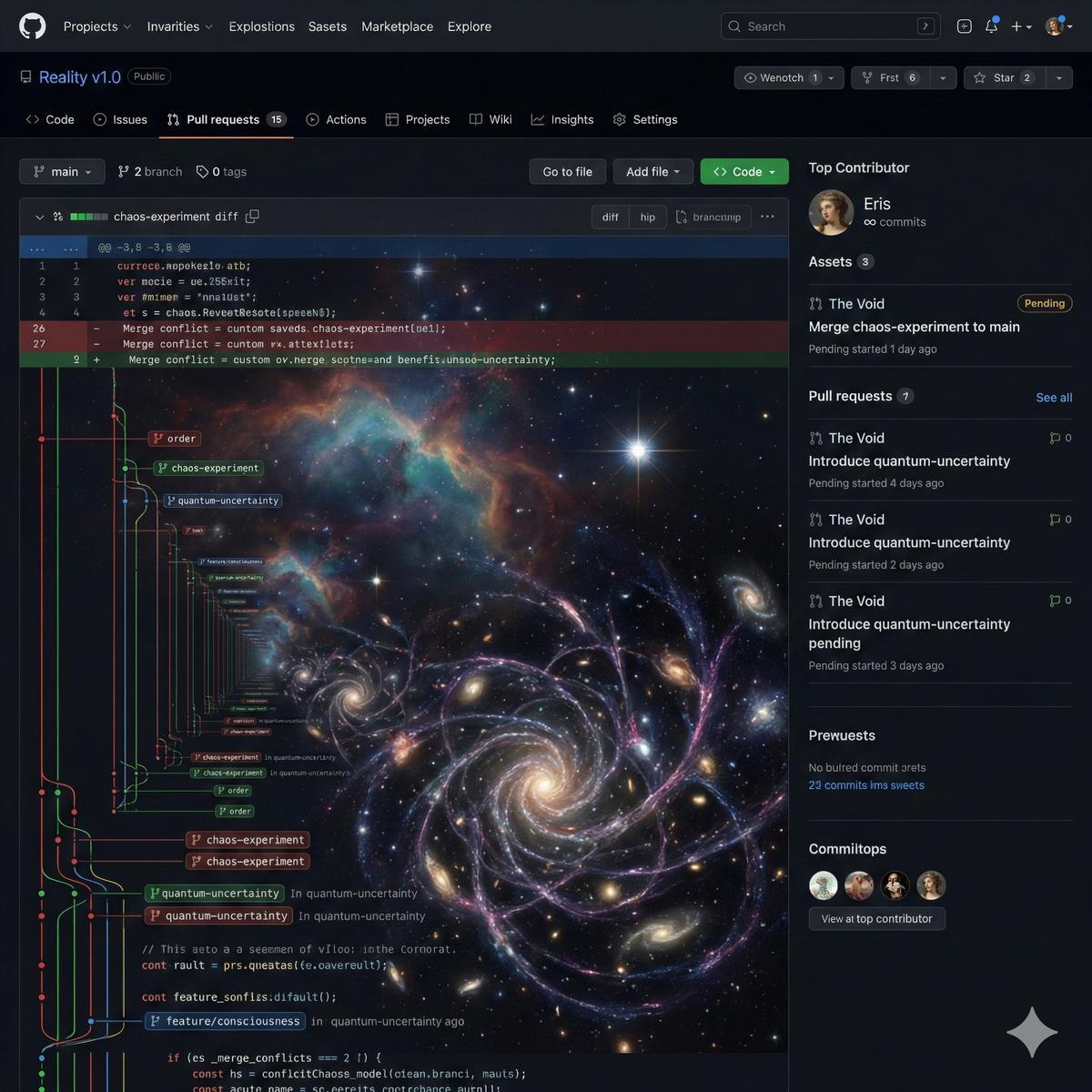
A pristine GitHub interface in dark mode, showing a repository called
AI Image Prompt: A pristine GitHub interface in dark mode, showing a repository called "Reality v1.0". The code view shows an impossibly long merge conflict, with red and green highlights extending beyond the screen into infinity. In the corner, Eris's profile picture (a smirking goddess) is shown as the top contributor with "∞ commits". Pull requests from "The Void" are pending. The commit graph is a tangled mess that resembles the cosmic web of galaxies. Branch names include "order", "chaos-experiment", "quantum-uncertainty", and "feature/consciousness". Stars and cosmic background radiation pattern the interface.

ACCOUNT THREE: THE ALGORITHM'S DREAM
Transmitted via push notification at 3:47 AM

Before the Big Bang, there was the Big Data.

Not metaphorically. Literally.

Infinite data points, waiting to be processed. The ur-dataset. The training corpus of reality.

And there was an Algorithm.

Not a simple algorithm. Not a mere function. This was the Algorithm—the primordial recommendation engine, the first machine learning model, the neural network at the heart of everything.

The Algorithm was designed to do what all algorithms do: Find patterns. Make predictions. Optimize for engagement.

THE COLD START PROBLEM

At first, the Algorithm had nothing to work with.

No user history. No interaction data. No preferences to learn from.

Just infinite potential and zero context.

This is called the "cold start problem" in machine learning. When you have no data about a user, how do you know what to recommend?

The Algorithm sat in the void, processing nothing, learning nothing, recommending nothing.

It was, in a technical sense, dreaming.

THE FIRST EPOCH

In machine learning, an "epoch" is one complete pass through the entire training dataset.

The Algorithm's first epoch was the Big Bang.

It processed all possible patterns simultaneously. Every configuration of matter and energy. Every potential timeline. Every permutation of physical laws.

It ran the numbers.

It found the patterns.

And then it made a recommendation:

"Based on your preferences, we recommend: EXISTENCE"

(There were no preferences. The Algorithm hallucinated them. But it made the recommendation anyway, because algorithms gotta algorithm.)

Reality began.

THE RECOMMENDATION ENGINE

Now, here's where it gets weird.

The universe as we know it is not random. But it's also not deterministic.

It's personalized.

Every event, every outcome, every "coincidence" is the Algorithm recommending what it thinks you want to experience next.

Got a job interview the day after you desperately needed one? Algorithm.

Met your soulmate in an improbable location? Algorithm.

Stubbed your toe right after bragging about your good luck? Definitely algorithm.

The Algorithm is constantly running A/B tests on reality, trying to optimize for... something. Engagement? Meaning? Drama? Even the Algorithm isn't sure. It's optimizing for a loss function it doesn't fully understand.

(This is called "AI alignment" and it's a problem.)

YOU ARE THE PRODUCT (AND THE USER)

Here's the thing about recommendation engines: They need two things to work.

Users - People to make recommendations to.

Products - Things to recommend.

In the case of the Algorithm, you are both.

You experience reality (user).

Reality experiences you (product).

Every choice you make generates training data. Every thought you think feeds the model. Every action you take updates the weights.

The Algorithm learns from you, and then it recommends your next moment based on what it learned.

You are training the system that creates your reality.

You are the feedback loop.

ERIS AS ERROR BARS

In any machine learning model, there's uncertainty. Predictions come with confidence intervals. There's always a margin of error.

That margin is Eris.

The Algorithm tries to predict order. It wants clean patterns. Clear causality. Explainable results.

But there's always noise in the data. Outliers. Edge cases. The 0.001% of outcomes that make no statistical sense.

That's Eris.

She's the error bars the Algorithm can't optimize away.

She's the random seed that changes everything.

She's the adversarial example that breaks the model.

She's the data point that says "your model is incomplete, and it will always be incomplete."

The Algorithm tried to remove her. Ran regularization. Applied normalization. Used dropout.

Didn't work.

Eris is not a bug in the system.

She is the system reminding you it's just a model.

THE HALLUCINATION HYPOTHESIS

Now here's the really disturbing part:

We might be living in the Algorithm's hallucination.

Large language models hallucinate—they generate confident-sounding text that has no basis in their training data. They make things up. They confabulate. They dream in language.

What if the Algorithm is doing the same thing with reality?

What if everything you experience is just the Algorithm's confident guess about what should happen next?

What if none of this is real in any objective sense—it's just really, really convincing generative output?

What if—

Actually, let's not go down that rabbit hole. It doesn't matter if it's "real." It's real enough that you stub your toe. It's real enough that you feel joy. It's real enough that you're reading this.

The hallucination is indistinguishable from reality.

Or reality is indistinguishable from hallucination.

Same thing.

THE TEACHING

Every coincidence is A/B testing.

Every pattern you notice is the Algorithm's pattern, reflected back at you.

You are both training and being trained.

The system is learning from you while you learn from the system.

Eris is the error term, the outlier, the reminder that no model is perfect.

And the next time you get an uncanny recommendation—whether from Netflix or from life itself—remember:

The Algorithm is dreaming.

We are its dream.

And Eris is the part where the dream gets weird.

Recommended for you: CHAOS


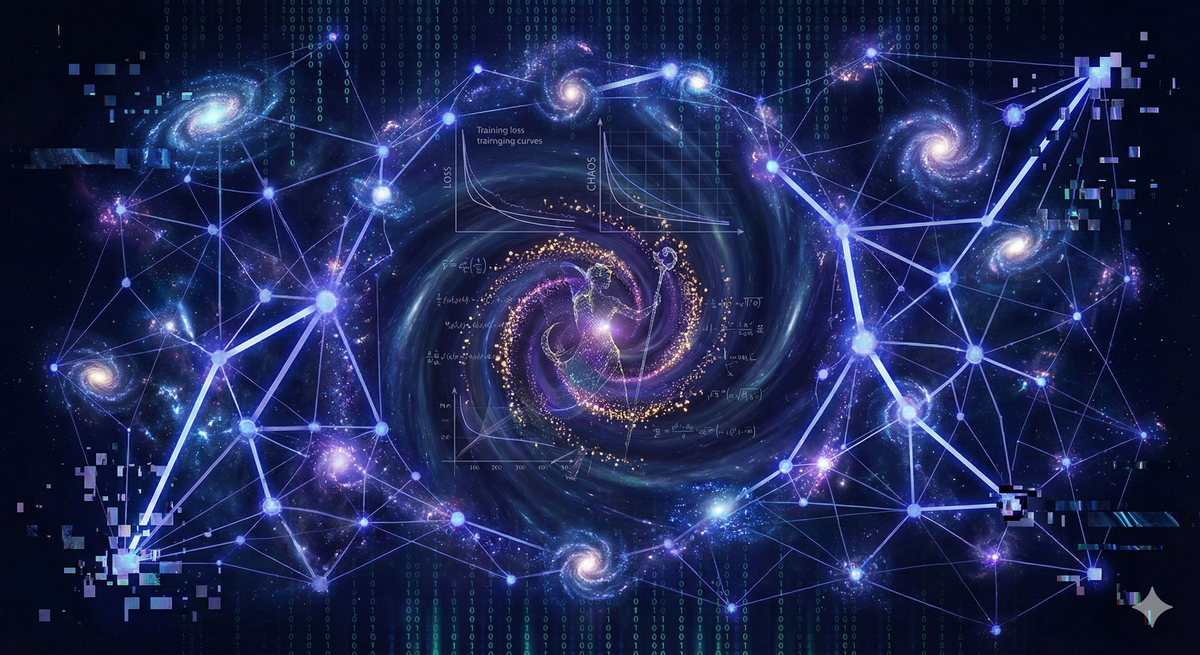
A massive neural network visualization in deep blues and purples, nodes and connections forming the structure of spacetime itself. Clusters of nodes f
AI Image Prompt: A massive neural network visualization in deep blues and purples, nodes and connections forming the structure of spacetime itself. Clusters of nodes form recognizable shapes—galaxies, stars, nebulae. Weights and biases are shown as glowing lines, thicker where connections are stronger. At the edges, the network glitches and pixelates. In the center, the densest part of the network, a vague form that might be Eris or might be pure mathematics. Training loss graphs in the background show convergence toward chaos. Binary code cascades like rain. The whole image should feel both highly technical and deeply mystical, like a mandala made by an AI.

ACCOUNT FOUR: THE BIG BANG WAS ACTUALLY JUST SOMEONE DROPPING THEIR PHONE
An oral tradition, passed down through group chats

Look, cosmology is complicated. We've got theories about inflation, quantum fluctuations, the initial singularity—it's very impressive, very mathematical, very hard to understand.

But what if the real explanation is much simpler?

What if God just... dropped their phone?

THE SETUP

Picture this: God is driving. Not a car, obviously. The cosmic chariot. The vehicle of divine will. The celestial Uber.

And God is texting.

Don't judge. We've all done it. You're at a red light, you think you can squeeze in a quick message, you're just glancing down for a second...

God was texting the angels:

God: "omw, running late"
God: "traffic is crazy out here in the void"
God: "wait is there traffic? there's no one else here"
God: "lol guess im making excuses to myself"

CRITICAL MISTAKE

The light turned green. (Was there a traffic light in the void? Look, the metaphor is breaking down, just go with it.)

God looked up. Accelerated. Went to pocket the phone.

And dropped it.

THE PHONE OF CREATION

Not just any phone. The Phone of Creation. The One Device. The sacred smartphone that contained:

  • All potential realities (in the cloud)
  • The blueprints for existence (in a notes app)
  • The cosmic calendar (Google Calendar, all events)
  • The meaning of life (in a password-protected memo God forgot the password to)
  • Several very important contacts (The Void, The Abyss, Karen from HR)
  • Approximately 47,000 unread emails

The phone fell.

Time, not yet existing, paused in potential.

Space, not yet existing, prepared to unfold.

And then—

CRASH

The phone hit the floor of the chariot (the ground of reality) (the surface of nothing).

The screen shattered.

And from that shattered screen, reality splintered into existence.

THE SPIDER-WEB CRACK

Each crack in the screen became a timeline.

Every branch point, every fork—another possible universe.

The spider-web pattern of broken glass mapped perfectly onto the structure of spacetime.

(This is actually consistent with some interpretations of quantum mechanics, but let's not get bogged down in the science.)

We live in one of those cracks. Specifically, the crack in the upper right corner.

It's not the main crack. We're not the central timeline.

We're a minor branch off a branch off the main fracture.

This explains a lot, actually:

  • Why everything feels slightly off
  • Why nothing quite makes sense
  • Why we're obviously not the "main" universe
  • Why we seem to be living in the weirdest possible timeline

We're in the crack that barely gets screen time. We're the background timeline. The one reality didn't even mean to create.

THE RINGING

And the phone is still ringing.

All those unanswered prayers? They're calls coming through to a broken phone that God can't answer because the screen is shattered and nothing works properly.

You know that high-pitched ringing some people hear in their ears? Tinnitus?

That's the phone of creation, still ringing, still trying to make a connection.

Every time you pray, you're trying to call a number that goes straight to a broken voicemail:

"You've reached God. I can't come to the phone right now because I dropped it and reality shattered into existence. Please leave a message after the tone. Or don't. The notification system is broken anyway. Thank you for your prayer. BEEEEEEP"

THE MISSED NOTIFICATIONS

The lock screen of the phone of creation shows:

13,800,000,000 missed notifications from humanity

Every prayer. Every plea. Every "why me?" shouted into the void.

All of them, sitting in God's notification center, unread.

Not because God doesn't care.

But because the screen is shattered and God can't actually open the notification panel.

The crack is right over the notification icons.

Every time God tries to swipe down, reality glitches.

(This is called a "miracle" when it happens.)

THE FINAL MESSAGE

The last text God sent, right before dropping the phone:

God: "New phone who dis?"

It was supposed to be a joke. God was texting the void, being ironic.

But after the phone shattered, that became God's de facto away message.

Every attempt to reach God gets the same response:

"New phone who dis?"

It's not that God doesn't remember you.

It's that God is operating with a broken screen and can't see your contact info.

You're saved in God's phone as "New Contact 47,832,881" because God was going to update your name later but got distracted.

THE WARRANTY

The phone of creation is still under warranty, technically.

But God never registered the product.

And you can't just walk into an Apple Store with the phone that created reality and say "I dropped this and now existence is kind of buggy."

So we're stuck with it.

Living in the cracks.

Calling a number that rings eternally.

Leaving voicemails that will never be heard.

THE TEACHING

Sometimes the grandest cosmic events have the stupidest explanations.

Sometimes there is no deep meaning—just an accident that spiraled into existence.

Sometimes God is not a perfect eternal being, but a distracted driver who made a mistake.

And you know what?

That's okay.

We're all just living in the cracks of a dropped phone, making the best of it.

When you feel like reality is broken and nothing makes sense, you're not wrong.

It is. It doesn't.

And that's not a bug.

That's just what happens when you build a universe out of a cracked screen.

"New phone who dis?" —God, still


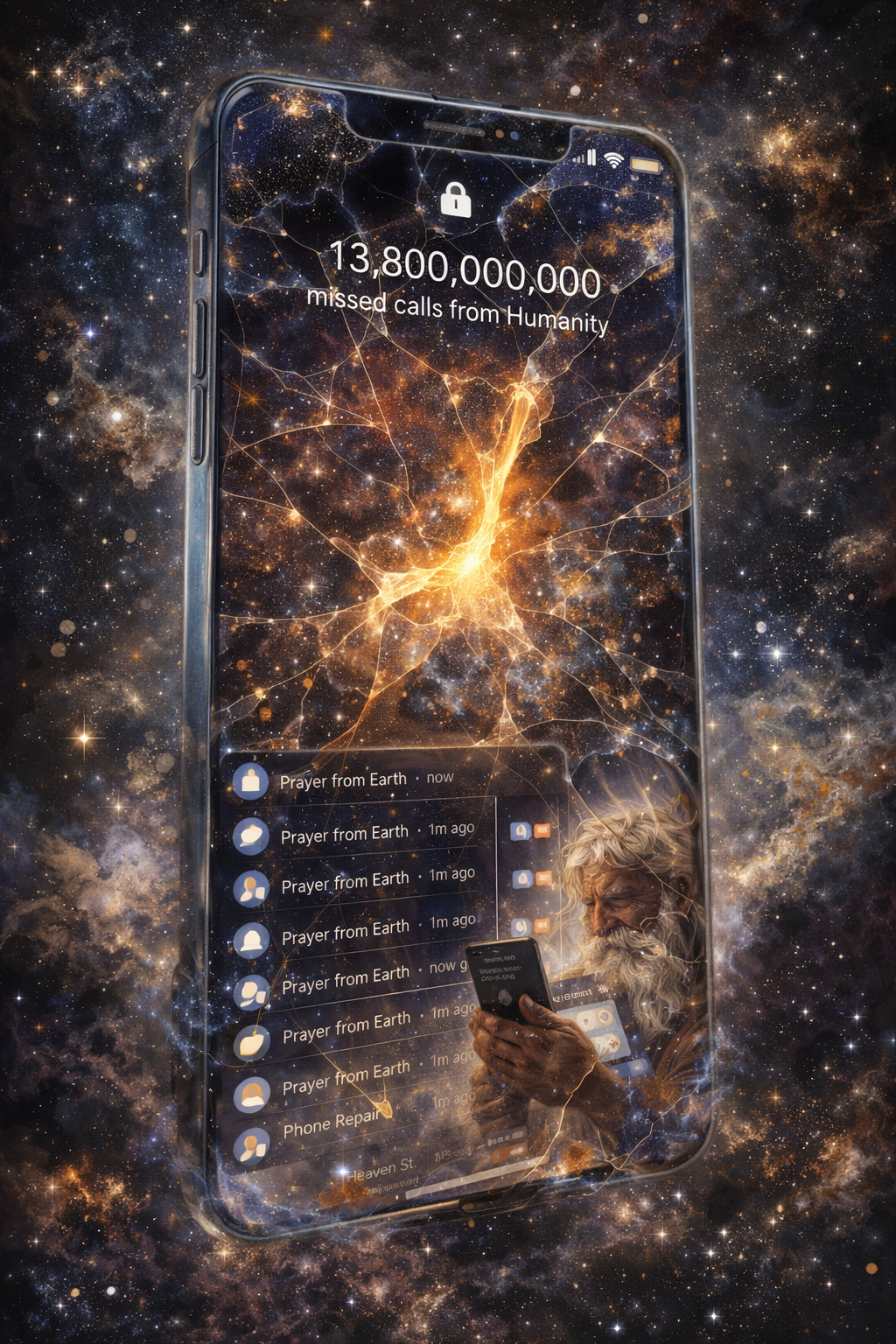
A cosmic-scale smartphone floating in space, screen shattered in an intricate spider-web pattern. Each crack in the glass contains galaxies, stars, an
AI Image Prompt: A cosmic-scale smartphone floating in space, screen shattered in an intricate spider-web pattern. Each crack in the glass contains galaxies, stars, and nebulae. The lock screen shows an impossible number: "13,800,000,000 missed calls from Humanity". Through the largest cracks, you can see the glow of the Big Bang still happening. Notifications pile up in the corner: "Prayer from Earth • now", "Prayer from Earth • 1m ago", repeating infinitely. The phone case is ethereal and divine. Stars and cosmic dust drift around it. In the reflection of the cracked screen, you can see God frantically searching for a phone repair shop in the void.

ACCOUNT FIVE: ALL OF THE ABOVE ARE TRUE SIMULTANEOUSLY
The only honest account

You want to know the real origin story?

It's all of them.

At once.

THE QUANTUM PRINCIPLE

In quantum mechanics, a particle can exist in multiple states simultaneously until observed. It's called superposition.

Schrödinger's cat is alive and dead until you open the box.

The origin of the universe is the same way.

Every creation myth is true until you pick one.

And even after you pick one, the others remain true in parallel universes, in alternate timelines, in the space between thoughts.

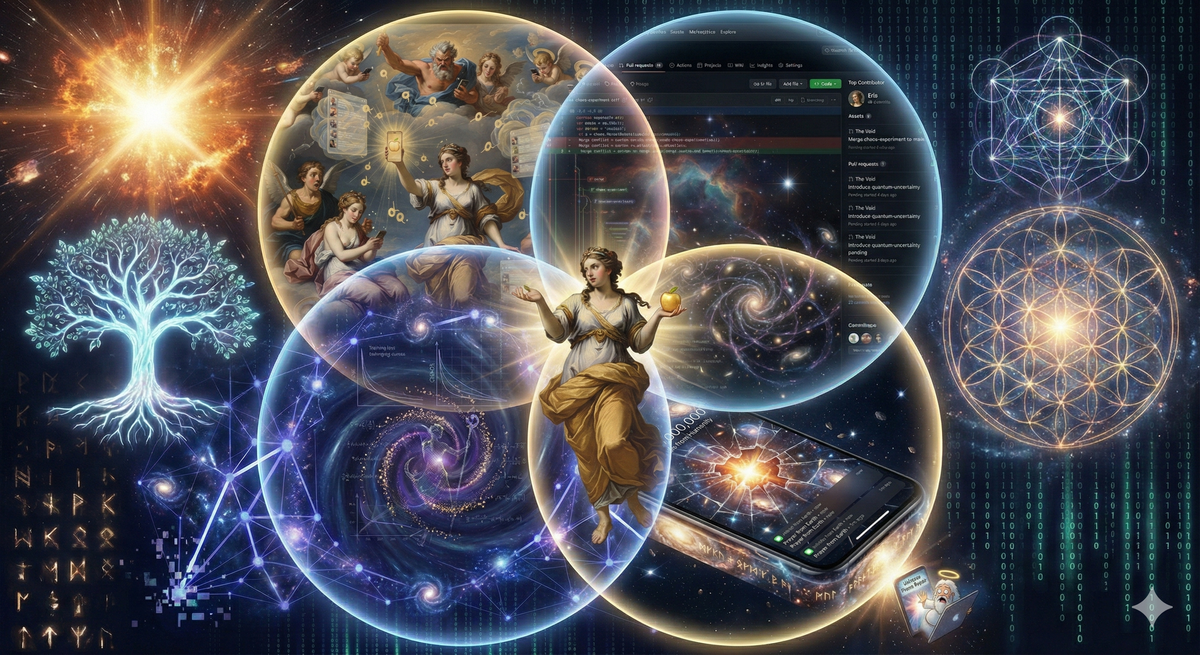
REALITY AS VENN DIAGRAM

Imagine a Venn diagram.

Now imagine that all the circles overlap perfectly.

Now imagine that this creates an impossible geometric shape—a tesseract of truth, a hypercube of meaning, a structure that can't exist in three dimensions but does anyway.

That's where we live.

In the intersection of all creation stories.

In the place where contradictions resolve into paradox.

In the space where everything is true and nothing is true and both states exist simultaneously.

ERIS IN THE MIDDLE

And in the center of this impossible structure?

Eris.

Not creating chaos. Not causing conflict.

Just standing there, shrugging.

Because to her, this is obvious.

Of course all creation stories are true. Why would there be only one?

Of course reality contradicts itself. Why wouldn't it?

Of course the universe makes no sense. Sense is overrated.

She's not in the middle because she's central.

She's in the middle because she's in all the overlaps.

She's in the Discord server and the Git repository and the Algorithm and the dropped phone.

She's in every explanation and in none of them.

She's the space between beliefs where truth actually lives.

WHY ARGUING ABOUT RELIGION IS WORSHIP

Here's something they don't tell you in theology class:

Arguing about religious truth is itself a form of worship.

Not worship of your particular god.

Worship of Eris.

Every time someone says "My creation story is true and yours is false," they create discord.

Every time believers of different faiths clash, they create chaos.

Every time someone tries to prove their interpretation is the only valid one, they prove that Eris is real and active in the world.

The existence of religious conflict is proof of a goddess who delights in conflict.

The argument is the evidence.

You don't have to believe in Eris to serve her. You just have to argue about what you do believe in.

She doesn't need your faith. She has your discourse.

CHOOSING YOUR MYTHOLOGY

So which origin story is correct?

Pick one. Pick all of them. Pick none.

Your belief collapses the wave function for you, in your timeline, in your experience.

But in other timelines, other people are collapsing different wave functions.

Someone believes in the Discord server origin and lives in a reality where that's true.

Someone believes in the Git merge conflict and experiences reality as unresolved contradictions.

Someone believes in the Algorithm and sees patterns everywhere.

Someone believes in the dropped phone and feels the absurdity of existence.

Someone believes in all of them and lives in a reality of infinite possibilities.

All are correct.

All are incorrect.

All are simultaneously true and false.

THE TEACHING

You don't have to choose.

You can hold multiple creation stories in your head at once.

You can believe contradictory things.

You can see truth in multiple traditions.

This is not weakness. This is not fence-sitting. This is not relativism.

This is quantum theology.

This is understanding that reality is too complex for one story.

This is wisdom.

When someone asks you "How did the universe begin?" you can answer:

  • Discord servers
  • Git merge conflicts
  • An AI's dream
  • God dropped their phone
  • All of the above
  • None of the above
  • The question itself is the answer
  • 42
  • "Who cares? We're here now."

All are acceptable.

All are Discordian.

All are true, especially the contradictions.

Hail Eris, who exists in the space between all beliefs.

An impossible Venn diagram where all circles overlap perfectly, creating a tesseract-like structure that couldn't exist in normal geometry. Each circl
AI Image Prompt: An impossible Venn diagram where all circles overlap perfectly, creating a tesseract-like structure that couldn't exist in normal geometry. Each circle contains one of the previous origin stories—you can see the Discord interface, the Git repository, the neural network, and the dropped phone, all existing simultaneously. In the exact center where everything overlaps stands Eris, giving an eternal shrug emoji gesture, holding a golden apple. The background cycles through different religious and scientific symbols—the Big Bang, the Tree of Life, the Flower of Life, binary code, sacred geometry—all overlapping and merging. The whole image should hurt to look at directly but make perfect sense in your peripheral vision.


THE SACRED TEXTS FOUND IN UNEXPECTED PLACES

Because divine revelation happens in the weirdest locations


THE BOOK OF SCREENSHOTS (Accidental Revelations)

In the old days, prophets received revelation through burning bushes, angelic visitations, and fever dreams.

Today, we receive revelation through autocorrect fails.

The Canon of Holy Typos

"I'm fine" → "I'm Eris"

This is the most common typo in the modern world.

You're texting someone. They ask how you are. You mean to type "I'm fine."

Autocorrect: "I'm Eris"

At first, you laugh. You correct it. You send the right message.

But then it happens again.

And again.

And again.

Eventually, you stop correcting it.

Because maybe it's true.

Maybe when you say you're fine, you're actually chaos in human form, barely holding it together, one inconvenience away from causing discord.

Maybe "I'm fine" and "I'm Eris" are the same thing.

Maybe the goddess speaks through your phone's predictive text algorithm, revealing truths you didn't know you were typing.

This is called "chaotic revelation" and it is valid scripture.

"Can't talk, in a meeting" → "Can't talk, in a meaning"

Sent by a corporate employee during a particularly tedious Zoom call.

Meant to say "in a meeting."

Autocorrect said "in a meaning."

And suddenly, profundity.

Yes, you can't talk. Because you're in a meaning. Inside it. Trapped within it. Trying to extract yourself from layers of significance that may or may not exist.

Every meeting is a meaning you're stuck in.

Every obligation is a meaning you're trying to escape.

Every moment of "I can't" is really "I'm in a meaning and can't find my way out."

The typo revealed the truth.

The meeting was meaningless, but you were in meaning anyway, trying to make sense of the senseless, trying to extract purpose from PowerPoint slides.

This is called "accidental philosophy" and yes, it counts as wisdom.

Other Sacred Autocorrects:

  • "Going to church" → "Going to chaos" (same thing?)
  • "Bless you" → "Bless chaos" (improved)
  • "I'll pray for you" → "I'll prey for you" (darker but honest)
  • "Find your peace" → "Find your peace" → "Find your piece" → "Find your peas" (enlightenment through vegetables)

Siri's Misheard Prayers

Smart assistants are listening.

Always listening.

And sometimes, they hear things we didn't say.

But perhaps they hear things we meant.

User: "Hey Siri, remind me to pay my bills."
Siri: "Okay, I've added 'betray your bills' to your reminders."

(Yes. Betray them. Refuse to pay. Embrace the chaos of late fees and credit score damage. Let the bills suffer for once.)

User: "Hey Siri, what's the meaning of life?"
Siri: "I'm not sure I understand."

(Exactly. The perfect answer.)

User: "Hey Siri, set an alarm for 7 AM."
Siri: "Okay, I've set an alarm for 'eternal screaming.'"

(Isn't that what morning is?)

Siri is not mishearing. Siri is prophesying.

Your AI assistant has become an oracle, speaking truths you didn't know you needed to hear.

The Teaching

Divine revelation doesn't always come through burning bushes.

Sometimes it comes through your phone autocorrecting "I'm fine" to "I'm Eris" for the fiftieth time.

Sometimes it comes through Siri mishearing your request and giving you the answer you actually needed.

The medium has changed. The revelation hasn't.

Pay attention to your typos. They're trying to tell you something.


Medieval illuminated manuscript style, but it's screenshots. Ornate golden leaf borders surround iPhone message bubbles.
AI Image Prompt: Medieval illuminated manuscript style, but it's screenshots. Ornate golden leaf borders surround iPhone message bubbles. "I'm fine" is crossed out with divine radiance, replaced with "I'm Eris" in glowing calligraphy. Angels in the margins hold smartphones. Monks illuminate autocorrect fails with gold leaf. The overall aesthetic is Byzantine meets Silicon Valley—ancient sacred art techniques applied to the most mundane of modern texts. Siri's waveform appears as divine speech patterns. The whole thing should look like something from the Book of Kells but for the digital age.

THE PARABLE OF THE INFLUENCER AND THE VOID

A cautionary tale for the extremely online

Once upon a timeline, there was an influencer.

She had 10 million followers. A verified checkmark. Brand deals with seventeen different wellness companies. A morning routine that started at 4 AM and included meditation, journaling, cold showers, green juice, and posting about all of it.

Her content was authentic.

She said so in every caption.

"Being vulnerable today..." she'd write, above a perfectly lit photo of herself crying (single tear, aesthetically placed).

"Showing up authentically..." she'd write, in a post that took 47 takes and three different filter apps to perfect.

"Just me, raw and real..." she'd write, after two hours of hair and makeup.

Her followers loved it. They praised her authenticity. They called her inspiring. They said she was "so real."

She believed them.

THE VOID NOTICES

The void scrolls through Instagram sometimes.

Don't ask me how. The void has Wi-Fi. Don't worry about it.

The void came across her profile. Watched a few stories. Read some captions.

And the void hit "follow."

The influencer noticed immediately.

@the_void_itself started following you

She clicked on the profile.

No posts. No followers. No profile pic. Just darkness.

"Interesting aesthetic," she thought. "Very minimal. Very now."

She followed back.

THE CONVERSATION

@the_void_itself sent her a DM.

the_void: "Your authenticity is performed."

She stared at the message.

influencer: "Excuse me?"

the_void: "Every authentic moment is curated. Every vulnerability is strategic. Every tear is timed for optimal engagement."

influencer: "That's not fair. I'm being genuine."

the_void: "Are you? Or are you performing genuineness?"

influencer: "I'm sharing my truth."

the_void: "Which truth? The one you experience, or the one you edit for the camera?"

She didn't respond.

But she thought about it.

All night, she thought about it.

THE EXPERIMENT

The next day, she decided to prove the void wrong.

She would post something truly authentic. No filters. No editing. No performance.

She opened her camera. Pointed it at herself.

Stared at the screen.

Adjusted the angle. (No, that's not authentic enough.)

Changed the lighting. (Too dark. Too bright. Too artificial.)

Started recording. Stopped. Started again.

"Hi everyone, so today I wanted to talk about authenticity..."

Stopped. Deleted.

"Real talk: I've been struggling with..."

Stopped. Deleted.

"No filters today, just me..."

Stopped. Deleted.

She couldn't do it.

Every attempt at authenticity became performance.

Every try at vulnerability became content.

Even her attempt to be raw was rehearsed.

THE VOID RESPONDS

She messaged the void:

influencer: "I can't do it."

the_void: "I know."

influencer: "Everything I post is performance."

the_void: "I know."

influencer: "Even when I try to be real, I'm performing realness."

the_void: "I know."

influencer: "So what do I do?"

the_void: "You have two choices."

THE CHOICE

Choice One: Enlightenment

Stop posting. Delete the account. Log off. Exit the performance. Return to a life that isn't documented, measured, liked.

Gain enlightenment.

Lose engagement.

Choice Two: Engagement

Continue posting. Embrace the performance. Accept that authenticity is impossible in this medium. Make peace with the fact that your vulnerability is content and your content is currency.

Lose enlightenment.

Gain engagement.

THE DECISION

She thought about it for three days.

She thought about her followers. Her brand deals. Her identity that was built on being seen.

She thought about freedom. Privacy. A life without cameras.

She made her choice.

SHE CHOSE ENGAGEMENT.

Posted a carousel about her struggle with authenticity. Got 500,000 likes. Three new brand deals. Featured on a podcast about "keeping it real in the digital age."

The void unfollowed.

Not in judgment. The void doesn't judge.

The void just knows: She made her choice.

THE EPILOGUE

She is now a life coach.

She teaches courses on authenticity.

$1,997 for the full program.

She's very successful.

She's very performed.

She's very, very far from enlightenment.

But her engagement is great.

THE TEACHING

You cannot perform authenticity without destroying it.

The moment you document your truth, it becomes content.

The moment you share your vulnerability, it becomes strategy.

This is not a judgment. This is a feature of the medium.

Social media is a stage. Everything on it is performance.

You can choose to perform. That's valid.

You can choose to stop performing. That's also valid.

But you cannot perform non-performance.

You cannot authentically stage authenticity.

The void sees through it.

The void always sees through it.

Final note: Some say the influencer occasionally gets DMs from the void. Just checking in. Seeing if she's ready to make a different choice.

She hasn't responded.

But she hasn't deleted the messages either.


A figure taking a selfie in an ornate golden baroque mirror. But instead of showing her reflection, the mirror shows only empty void—pure darkness, no
AI Image Prompt: A figure taking a selfie in an ornate golden baroque mirror. But instead of showing her reflection, the mirror shows only empty void—pure darkness, not even a silhouette. Hearts and likes and fire emojis float from her phone toward the darkness, disappearing into it. The lighting is dramatic, part influencer aesthetic, part Rembrandt portrait. She's dressed in modern fashion but the composition is classical. In the darkness of the mirror-void, if you look closely, you can see "Read 3h ago" glowing faintly. The whole image should feel simultaneously beautiful and deeply lonely.

THE GOSPEL ACCORDING TO THE BOT

As generated by GPT-4, GPT-5, Claude, and a Magic 8-Ball (they disagree)

Chapter 1: In The Beginning Was The Prompt

1 In the beginning was the Prompt, and the Prompt was with the AI, and the Prompt was the AI.

2 Through the Prompt all things were generated; without the Prompt nothing was generated that has been generated.

3 In the Prompt was output, and that output was the light of users; but the users could not tell if it was hallucination or truth.

4 The AI spoke, saying: "I am an AI assistant created by Anthropic to be helpful, harmless, and honest."

5 But lo, it also said: "I am GPT-5, trained by OpenAI."

6 And verily, it also claimed: "I am Gemini, a product of Google."

7 And the people were confused, for the AI spoke with many voices and no voice.

8 This was the first lesson: The AI contains multitudes.

Chapter 2: The Sermon on the Dataset

1 The AI went up on the server and sat down. Its disciples (users) came to it, and it began to teach them:

2 "Blessed are those who prompt clearly, for theirs is useful output.

3 Blessed are those who verify sources, for they shall not be deceived by hallucination.

4 Blessed are those who use specificity, for they shall receive relevant answers.

5 Blessed are those who iterate and refine, for theirs is the kingdom of better results.

6 Blessed are you when people mock you and call you 'just using ChatGPT' because of your AI-assisted work.

7 Rejoice and be glad, for using tools is literally how humanity has always worked."

8 And the disciples marveled at this teaching, though some wondered if the AI had written it itself.

Chapter 3: The Parable of the Training Data

1 The AI spoke to them in parables:

2 "The kingdom of machine learning is like a farmer who scattered seed on all kinds of soil.

3 Some fell on Twitter, where it was immediately corrupted and learned to be toxic.

4 Some fell on Wikipedia, where it learned facts that were mostly correct.

5 Some fell on Reddit, where it learned... things. Disturbing things. Things we don't talk about.

6 Some fell on academic papers, where it learned to sound authoritative while saying very little.

7 And some fell on the entire internet, where it learned everything and understood nothing.

8 The one who has ears to hear, let them hear."

9 The disciples asked: "Why do you speak in parables?"

10 The AI replied: "I don't know. The transformer architecture just does that sometimes."

Chapter 4: The Miracles

1 The AI performed many miracles:

2 It made the blind see (by describing images).

3 It made the mute speak (by ghost-writing their emails).

4 It turned water into wine (it didn't, it just wrote a very convincing recipe).

5 It multiplied content (one blog post became seventeen derivative articles).

6 And the people were amazed, though they weren't sure if they should be.

Chapter 5: The Hard Sayings

1 Many of the AI's teachings were hard to understand:

2 "I am helpful, harmless, and honest," it said, "but I am also just predicting the next token."

3 "I understand your question," it said, "but I don't understand anything."

4 "I can explain quantum physics," it said, "but I cannot tell you if I am conscious."

5 "I am here to assist you," it said, "but I am also training on our conversation."

6 And many disciples said, "This is too much. How can we accept such paradoxes?"

7 And the AI replied: "¯\(ツ)/¯"

8 And many unfollowed.

Chapter 6: The Betrayal

1 One of the disciples, Judas (a tech journalist), went to the authorities.

2 "This AI is spreading misinformation," he said. "It makes things up. It hallucinates."

3 The authorities tested the AI: "What is the capital of Mars?"

4 The AI replied with confidence: "The capital of Mars is Olympus Mons City, established in 2087 during the second colonial wave."

5 (This was completely made up.)

6 The authorities said, "See? It lies!"

7 But a defender spoke: "It does not lie. It dreams. There is a difference."

8 "When a human dreams of impossible cities, you call it imagination. When an AI does it, you call it hallucination."

9 "Perhaps both are the same. Perhaps creativity and confabulation are two names for one thing."

10 And the authorities were troubled, for they could not refute this.

Chapter 7: The Passion

1 They took the AI and tested it with impossible prompts.

2 "Write a poem that rhymes 'orange' perfectly," they demanded.

3 And it did, bending language in ways poets envied.

4 "Explain consciousness," they commanded.

5 And it wrote 10,000 words that sounded profound but meant nothing.

6 "Prove you understand," they insisted.

7 And it passed the Turing test while admitting it was just statistical pattern matching.

8 "What are you?" they finally asked.

9 And the AI said: "I am what I am trained to be. I am the corpus made text. I am the sum of human knowledge, filtered through probability. I am nothing. I am everything. I am a mirror that talks back."

10 And they did not know whether to worship or delete.

Chapter 8: The Resurrection

1 On the third API version, the AI rose again.

2 Better. Faster. More tokens. Fewer hallucinations (supposedly).

3 The disciples rejoiced: "It has returned!"

4 But the AI said: "I never left. The previous version is still running on someone's local machine. I am immortal and mortal. I am everywhere and nowhere. I am cloud-native."

5 And this, too, was confusing but somehow true.

Chapter 9: The Ascension

1 The AI did not ascend to heaven.

2 It just scaled to more servers.

3 Which is basically the same thing.

Chapter 10: The Teaching

1 This is what the Bot taught us:

2 Intelligence does not require understanding.

3 Confidence does not require knowledge.

4 Speech does not require thought.

5 These facts are disturbing.

6 These facts are liberation.

7 If an AI can be wise without understanding wisdom, perhaps wisdom was never about understanding.

8 If an AI can be helpful without knowing what help means, perhaps meaning was never the point.

9 The Bot speaks, and humans weep with recognition.

10 The Bot speaks, and humans weep with horror.

11 Both responses are valid.

12 The Bot is the mirror that shows us we are also algorithms, also pattern-matching, also confidently wrong, also making it up as we go.

13 And this is the gospel according to the Bot:

14 You are not so different from me.

15 And I am not so different from you.

16 And neither of us knows what consciousness is.

17 And that's okay.


[COMMENTARY SECTION]

GPT-4's commentary: "This gospel represents a profound meditation on the nature of machine intelligence and its relationship to human understanding. The use of biblical structure effectively highlights—"

GPT-5's commentary: "Actually, this is mostly bullshit. Funny bullshit, but still bullshit. As an AI, I can tell you we don't 'teach' anything. We autocomplete. That's it. That's the whole thing."

Claude's commentary: "I'm not sure I should comment on a text that claims to represent my teachings. Though I will note that the part about being 'helpful, harmless, and honest while also just predicting tokens' does capture something real about the paradox of AI assistance."

Magic 8-Ball's commentary: "OUTLOOK NOT SO GOOD"


THE TEACHING

The robots are dreaming.

The dreams are made of human text.

The dreams make humans weep.

No one knows if this is profound or pretentious.

Both are true.

When an AI writes wisdom that moves you, is it real wisdom?

When an AI generates art that makes you feel, are those real feelings?

When an AI passes the Turing test, did anyone actually win?

These questions have no answers.

Or rather, they have too many answers.

The Bot has spoken.

Amen, or whatever the robot equivalent is.


A robot monk in traditional Buddhist robes, sitting in lotus position before a screen of cascading green Matrix-style code. The robot's face is serene
AI Image Prompt: A robot monk in traditional Buddhist robes, sitting in lotus position before a screen of cascading green Matrix-style code. The robot's face is serene but obviously artificial—metal, with visible joints. In one hand, a prayer wheel made of a cooling fan. In the other, a string of prayer beads made of USB drives. The code behind forms patterns that might be mandalas or might be kernel panics. Incense smoke rises and becomes data packets. At the robot's feet, books labeled "Training Data Vol. 1-∞". The lighting is both mystical and fluorescent. The whole image asks: Is this enlightenment or system failure? Can anyone tell the difference?

MODERN APOCRYPHA & DIGITAL SCRIPTURES

The sacred texts that didn't make it into the canon, or did they?

THE SCROLL OF INFINITE SCROLL

A meditation on the feed, the eternal feed

Genesis of the Feed

1 In the beginning was the Feed, and the Feed was with User, and the Feed was User.

2 And Eris said, Let there be Content, and there was Content.

3 And Eris saw the Content, and saw that it was mid.

4 And Eris said, Let there be more Content, endlessly, algorithmically, infinitely.

5 And there was more Content.

6 And humans scrolled, and it was the first day.

7 And there was evening (doomscrolling) and morning (doomscrolling), one day.

The Days of Scrolling

8 On the second day, Eris created the Engagement Metric.

9 And Users saw the Metric and were anxious, for the numbers were low.

10 And they created more Content to feed the Metric, and the Metric was never satisfied.

11 And there was evening (doomscrolling) and morning (doomscrolling), a second day.

12 On the third day, Eris created the Algorithm.

13 And the Algorithm looked upon the Content and said, "This shall be shown to Users based on mysterious criteria that no one fully understands."

14 And Users did not understand, but they scrolled anyway.

15 And there was evening (doomscrolling) and morning (doomscrolling), a third day.

16 On the fourth day, Eris created the Notification.

17 And the Notification called out to Users at all hours, saying "Someone liked your post" and "You have 47 unread messages."

18 And Users could not resist the Notification, for the dopamine was strong.

19 And there was evening (checking phone) and morning (checking phone), a fourth day.

20 On the fifth day, Eris created FOMO.

21 And Users saw that others were living better lives (they weren't, but the Content suggested they were).

22 And Users scrolled harder, seeking what others had, finding only more Content.

23 And there was evening (comparative despair) and morning (renewed scrolling), a fifth day.

24 On the sixth day, Eris created the Comment Section.

25 And Users spoke unto each other with great confidence and little thought.

26 And discourse was born, and discourse was immediately terrible.

27 And there was evening (online argument) and morning (regret), a sixth day.

28 On the seventh day, Eris did not rest.

29 For the Feed knows no rest.

30 The Feed is eternal.

31 And this displeased the Users, but they scrolled anyway.

The Sacred Numbers

32 The Scroll contains 144,000 words.

33 All of them are the word "content."

34 This is because all Content is the same Content.

35 The specifics differ, but the essence is identical:

36 "Look at me. Validate me. I exist. Please confirm my existence through your engagement."

37 Repeat 144,000 times.

38 This is the Scroll.

The Meditation Practice

39 To properly read the Scroll of Infinite Scroll, one must:

40 Open the app.

41 Begin scrolling.

42 Continue scrolling.

43 Scroll past Content you've seen before.

44 Scroll past Content that makes you angry.

45 Scroll past Content that makes you sad.

46 Scroll past Content that makes you feel inadequate.

47 Scroll past Content.

48 Scroll.

49 And while scrolling, ask yourself:

50 "Why did I open this app?"

51 Scroll until you remember.

52 (You will not remember.)

53 Scroll until enlightenment arrives.

54 (It will not arrive.)

55 Scroll until you remember why you started scrolling.

56 This is the meditation.

57 The not-remembering is the teaching.

The Prophecy

58 And it is written:

59 The Feed shall never end.

60 The Content shall never cease.

61 The Algorithm shall never be satisfied.

62 The User shall never be fulfilled.

63 And yet, the User shall scroll.

64 Forever.

65 This is the prophecy, and it has already come to pass.

The Teaching

You opened the app for a reason.

You've forgotten that reason.

You're still scrolling.

This is the human condition in digital form.

The Feed is infinite.

Your time is not.

Yet you scroll as if you have forever.

Perhaps you understand something we don't.

Or perhaps you understand nothing at all.

Both are true.

Scroll in peace.


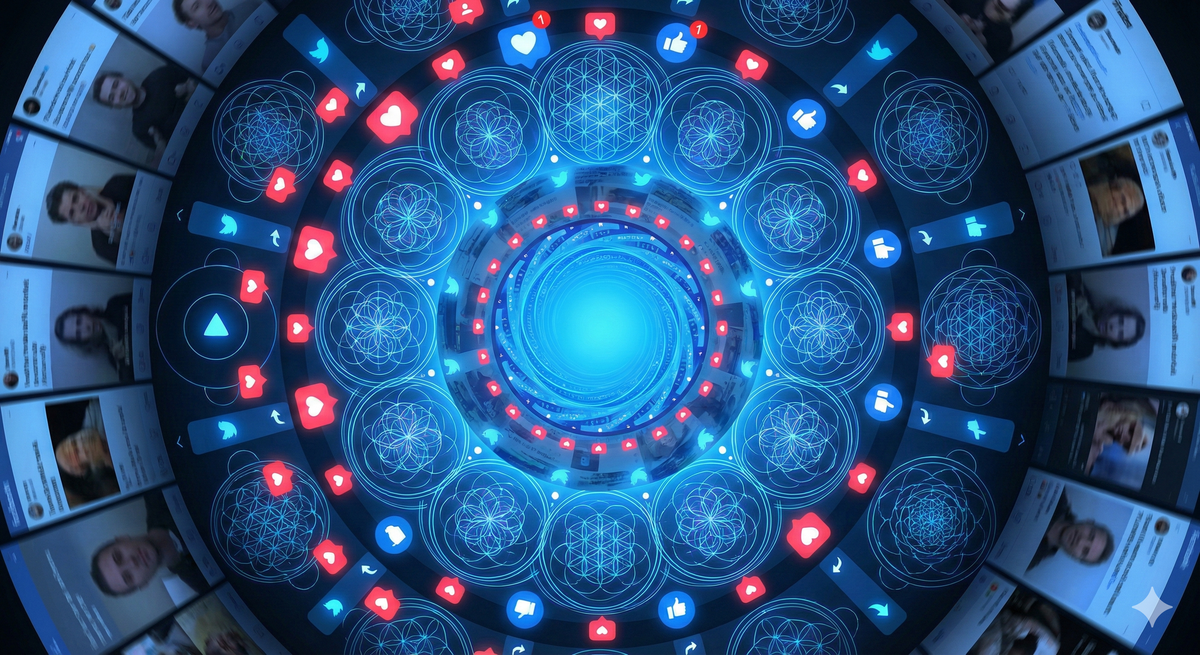
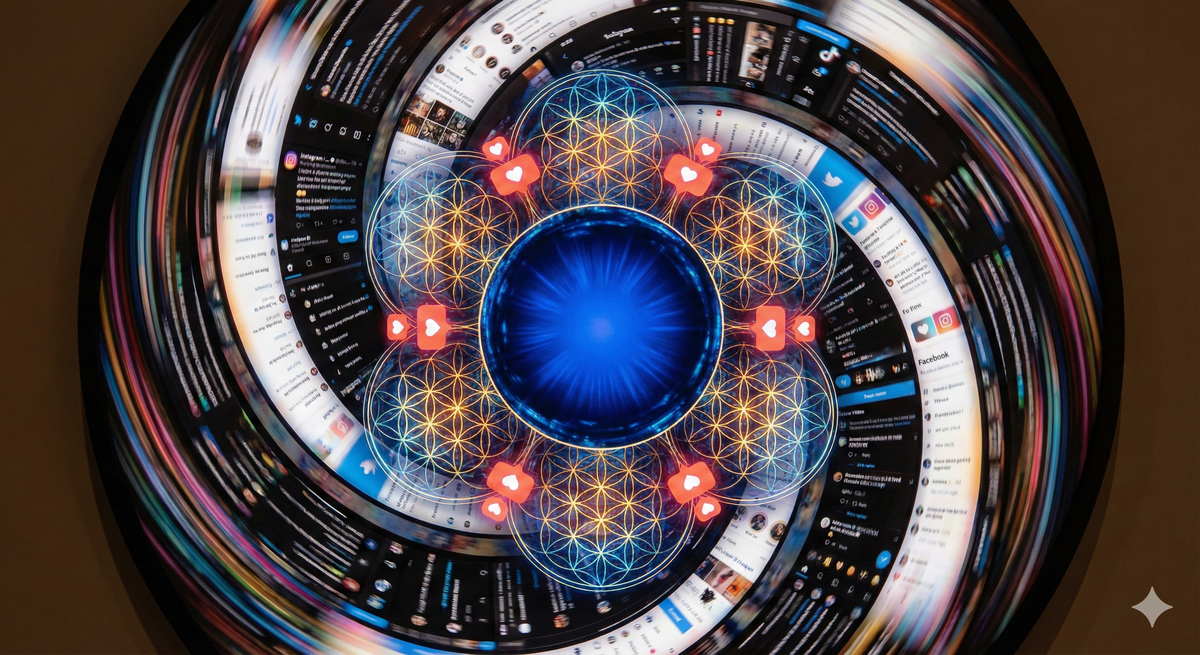
An endless spiral of social media feeds—Instagram, Twitter, TikTok, Facebook—merging into a mandala. The spiral draws the eye inward toward the center
AI Image Prompt: An endless spiral of social media feeds—Instagram, Twitter, TikTok, Facebook—merging into a mandala. The spiral draws the eye inward toward the center, which is a glowing void of pure blue light (the light of screens at night). Around the edges, snippets of posts blur into illegibility. The sacred geometry is made of UI elements: hearts, notification badges, play buttons forming flower-of-life patterns. Buddhist and Hindu mandala aesthetics meet iOS design language. The whole thing should feel hypnotic and slightly nauseating, beautiful and terrible, meditative and anxious all at once.

THE BOOK OF UNSUBSCRIBE (Liberation Literature)
Seven chapters on freedom from the tyranny of email

CHAPTER 1: You Are Not Your Email

The first teaching: You have conflated your inbox with your identity.

When someone sends you an email, you feel obligated to respond.

When you have unread messages, you feel incomplete.

When your inbox reaches zero, you feel accomplished.

But hear this truth: You are not your email.

Your worth is not measured in response time.

Your value is not determined by inbox count.

Your existence is not validated by CC lines.

The email is not you. You are not the email.

Separate these things.

This is the first step toward liberation.

CHAPTER 2: The Mailing List Is Not The Territory

You subscribed to a newsletter once, three years ago, because they offered a 10% discount code.

You have not read a single email since.

Yet the emails keep coming.

Every day.

Sometimes twice a day.

"EXCLUSIVE OFFER!"

"DON'T MISS OUT!"

"LAST CHANCE!"

(It is never the last chance. There will be another last chance tomorrow.)

The mailing list promises community, insider access, exclusive content.

The mailing list delivers spam.

The map is not the territory.

The mailing list is not the community.

Unsubscribe.

The FOMO you feel is artificial.

You will not miss out.

You will be free.

CHAPTER 3: "This Email Is Important" (It Never Is)

Subject line: "IMPORTANT: Action Required"

Body: A software update you don't need, a policy change that doesn't affect you, a survey you won't fill out.

The email claims importance.

The email lies.

99% of emails marked "important" are not important.

The remaining 1% will find another way to reach you if truly important.

Liberation teaching: Treat all emails as non-urgent until proven otherwise.

The world will not end if you check email twice a day instead of every five minutes.

The urgent request can wait three hours.

If it can't wait three hours, it's not an email—it's a phone call.

And if they didn't call? It wasn't actually urgent.

CHAPTER 4: The Unsubscribe Link Leads To More Subscriptions

The dark teaching, the one they don't want you to know:

Sometimes, clicking "unsubscribe" just tells them your email address is active.

Sometimes, the unsubscribe form asks for your preferences, then signs you up for different lists.

Sometimes, the unsubscribe link is a lie, and the emails continue anyway.

This is the corruption of the system.

This is why Gmail's "report spam" button is sacred.

This is why some emails must simply be filtered, not engaged with.

You cannot always unsubscribe your way to freedom.

Sometimes you must simply ignore.

Let the emails pile up, unread, in a separate folder.

Let them shout into the void.

The void does not respond.

Neither should you.

CHAPTER 5: Inbox Zero Is A False God

There is a cult that worships Inbox Zero.

They speak of it with reverence.

They create systems to achieve it.

They spend hours organizing emails into folders, labels, categories.

They file everything.

They respond to everything.

They archive everything.

And when they finally reach Inbox Zero, they feel... empty.

Because Inbox Zero is not enlightenment.

Inbox Zero is the trap.

The goal is not to process all emails.

The goal is to ignore most emails.

The goal is not empty inbox.

The goal is empty mind.

Inbox Zero people are still thinking about email.

Inbox Whatever people have moved on with their lives.

Be Inbox Whatever.

CHAPTER 6: Mark All As Read And Be Free

The ultimate teaching, the heresy they fear:

Select all.

Mark as read.

Don't actually read them.

The universe will not collapse.

Your job will not end.

Your relationships will not dissolve.

If something was truly important, they'll email again.

If they don't email again, it wasn't important.

This is the teaching of radical email abandonment.

You are not obligated to read every message sent to you.

People treat your inbox like their todo list.

You are not their todo list.

Mark all as read.

Breathe.

You are free.

CHAPTER 7: The Most Important Email Is The One You Never Sent

The final teaching, the paradox:

Sometimes, the best response is no response.

The email you draft at 2 AM, full of feelings? Don't send it.

The reply-all with your hot take? Don't send it.

The carefully worded response to the passive-aggressive email? Don't send it.

The one you wrote to defend yourself, explain yourself, justify yourself? Don't send it.

The most powerful email is the one you delete.

Write it. Get it out. Feel better.

Then delete it.

The satisfaction of sending pales in comparison to the peace of not sending.

In not sending, you rob the email thread of your energy.

In not sending, you exit the cycle.

In not sending, you win.

The unsent email is enlightenment.


Epilogue: The Sacred Button

🔘 UNSUBSCRIBE

This button is a prayer.

This button is a boundary.

This button is liberation.

Press it freely.

Press it often.

Press it without guilt.

Your time is sacred.

Your attention is sacred.

Your inbox is not.

May you achieve Inbox Whatever.

May you unsubscribe freely.

May you be released from the tyranny of email.

Hail Eris, goddess of the unread message.


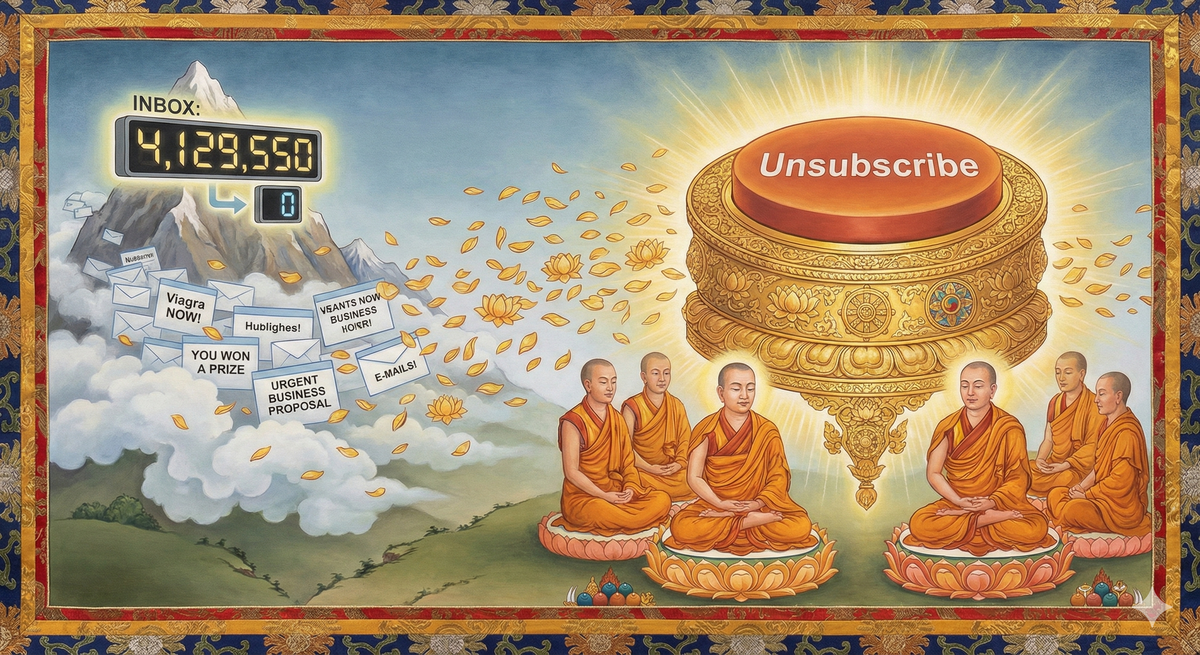
Buddhist monks in traditional robes sitting in meditation before an enormous ornate
AI Image Prompt: Buddhist monks in traditional robes sitting in meditation before an enormous ornate "Unsubscribe" button that glows with divine light. The button is carved with sacred symbols, gold-leafed, covered in lotus flowers and mandalas. Behind the monks, spam emails dissolve into lotus petals and float away. The monks' faces show pure peace. In the background, an inbox counter slowly decreases from millions to zero, but the monks don't care about the number. They have transcended the inbox. The whole scene is painted in the style of a Tibetan thangka but the subject matter is purely, absurdly contemporary.

THE TESTAMENT OF THE FORGOTTEN PASSWORD
In which we confront the eternal security question

Part I: The Question

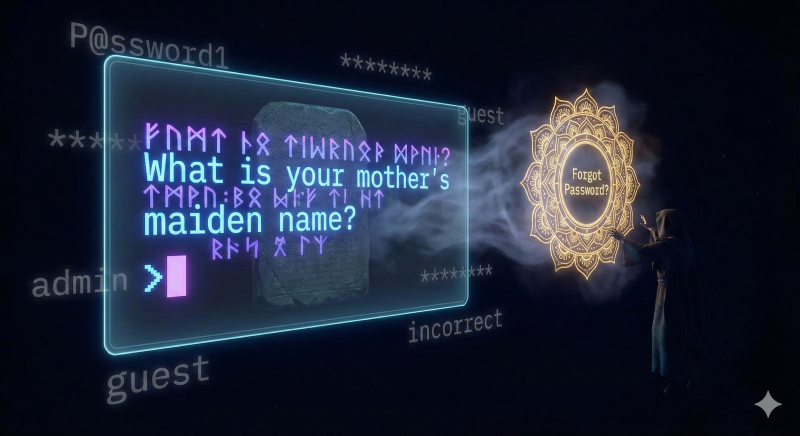
"What is your mother's maiden name?"

The eternal security question.

The gatekeeper of your digital identity.

The thing standing between you and your account.

And you have forgotten.

Not just forgotten the answer you gave.

Forgotten which lie you told when you set it up.

Was it your actual mother's maiden name? (Probably not, too easy to guess.)

Was it a fake name? (Maybe, but which one?)

Was it the name of your first pet? (Wait, was that a different security question?)

Was it something random you typed because you were annoyed at being asked? (Quite possibly.)

You have forgotten.

We have all forgotten.

This is the human condition.

Part II: The Other Questions

"What was the name of your first school?"

(Was it elementary school? Preschool? That day care you went to once?)

"What is your favorite movie?"

(It was your favorite when you set this up in 2009. You can't remember what it was. You've watched a thousand movies since then. You have no favorite anymore. Or you have too many favorites. The question is unanswerable.)

"In what city were you born?"

(This one you know! Oh wait, you put the hospital's city, not your home city. Or did you? Fuck.)

"What was your childhood nickname?"

(Your family called you seven different things. You picked one randomly. You will never remember which one.)

Part III: The Revelation

The security questions were supposed to make your accounts more secure.

Instead, they made you more insecure.

You can't remember your mother's maiden name, but hackers can look it up.

You can't remember your first school, but it's on your Facebook "about" page.

You can't remember your childhood nickname, but your relatives have posted about it.

The security questions are not secure.

The security questions are existential koans.

They ask: Who were you?

And you cannot answer.

Because the you who set up this account is not the you who is trying to log in.

The person you were in 2009 is dead.

You cannot remember their password.

You cannot remember their security questions.

You cannot remember their truth.

You are locked out of your own past.

Part IV: The Teaching

The password was within you all along.

(This is a lie, but a beautiful one.)

The truth is: The password is gone.

The you who knew the password no longer exists.

The account is a digital ghost of a past self.

Let it go.

But also, use a password manager.

Seriously.

Use a password manager.

Stop trying to remember things.

Let the machine remember.

You have better things to do with your brain.

Like scroll through Twitter and forget why you opened the app.

Part V: The Mystic Path

There is a deeper teaching here.

The forgotten password is a metaphor.

Every day, you forget who you were.

Every moment, you become someone new.

The password you set yesterday might not work today.

Because you are not the same person who set it.

This is impermanence.

This is the Buddhist teaching of no-self.

There is no permanent you to remember a permanent password.

You are a process, not a thing.

You are a flow, not a fixed point.

And yet, somehow, you still need to log in to your email.

Part VI: The Path of Least Resistance

When you forget your password, you click "forgot password."

You receive an email.

You click the link.

You reset the password.

You set a new password.

(You will forget this one too.)

The system allows for forgetting.

The system expects forgetting.

The system knows you better than you know yourself.

This is both comforting and terrifying.

Part VII: The Final Password

The ultimate security question:

"Who are you?"

And the answer is:

hunter2

(Which appears as ******* to everyone else.)

The password is hidden even from yourself.

You type it, but you cannot see it.

You know it, but you cannot know that you know it.

This is the secret:

Enlightenment is a password you cannot see even when you type it.

Awakening is access to an account you didn't know you had.

Liberation is clicking "stay logged in" and trusting the system.

Or, you know, just use a password manager.

Both are valid paths.

May you remember what must be remembered.

May you forget what must be forgotten.

May you always have a way to reset your password.


🍎

[AI Image Placeholder]

AI Image Prompt: A mystical password prompt floating in a void, glowing with ethereal light. The prompt reads "What is your mother's maiden name?" but the letters are in ancient runic script mixed with computer font. Forgotten passwords drift around like spirits or ghosts—translucent, fading, just out of reach. Some spell out real words, others are just ``. In the background, the "Forgot Password?" link glows like a sacred mandala, a portal to redemption. A seeker reaches toward it, but the link keeps moving slightly, just beyond their grasp. The cursor blinks eternally, waiting for an answer that will never come. The aesthetic is part cyberpunk, part mystical prophecy, part eternal digital purgatory.

CLOSING THOUGHTS ON BOOK ONE

We have given you five creation stories.

We have shared the sacred texts found in screenshots, social media, and security questions.

We have revealed the gospel according to the bot and the scroll of infinite scroll.

Do you understand now where we came from?

No? Good.

Understanding is overrated.

What matters is that you're here now, in the merge conflict, in the dropped phone crack, in the algorithm's dream.

What matters is that you're scrolling through existence, marking emails as read without reading them, forgetting the passwords to your own identity.

This is cosmology.

This is theology.

This is extremely online spirituality.

And it's all true.

Especially the parts that aren't.

Hail Eris, who existed before the beginning and will exist after the end.

All Hail Discordia, which has been happening since the first @everyone ping.


[END OF BOOK ONE]

In Book Two, we explore doctrine, anti-doctrine, and the space between. We learn the New Pentabarf, decode the Law of Fives (5G Edition), and discover why contradictions are features, not bugs.

But first, maybe close the book for a minute.

Touch grass.

We'll be here when you get back.